by Cassandra Balentine
Closed-loop inserters utilize file-based processing, adding a layer of security to the transactional print and finishing process.
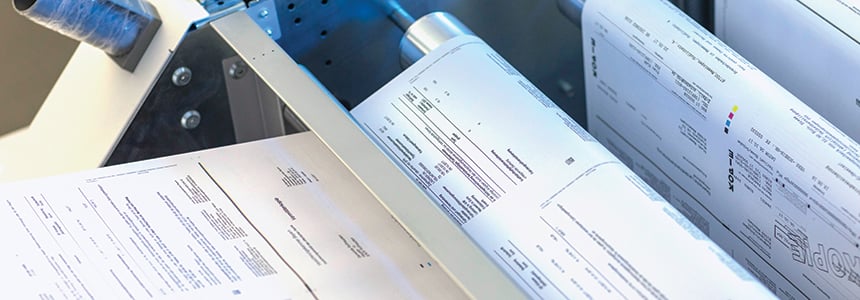
Above: Epic from BlueCrest is a high-speed inserting system designed to deliver fast and accurate results.
File-based processing represents a significant shift in how transactional mail operations manage job integrity. “The core advantage is simple, you know exactly what you are supposed to produce before production begins. The inserter receives a structured file that defines every mail piece in the job—how many pages, which inserts, what selective content—and compares actual production output against that known manifest in real time,” explains Eddy Edel, VP of product management, BlueCrest.
Every major player that manufactures inserters for the fulfillment of inserting mail into an envelope prior to sending to the recipient offers their own proprietary variant of file-based inserting, according to Bow Smith, manager, Technical Sales, BW Converting.
Without file-based processing, Edel says an operator running a job has no reliable way to know whether the first or last ten pieces were missed. “The total count might appear on a job ticket banner page, but it is not embedded in the production workflow itself. File-based processing closes that gap.”
File-Based Benefits/Limitations
In addition to providing piece-level accountability, file-based inserting systems provide detailed records, such as count and reprint reports.
For many clients, Kelly McManus, senior director, production mail, North America, Quadient, believes it’s enough for some to know that the correct documents are inserted into the proper envelopes, but for others—especially where compliance is required like in healthcare and insurance with HIPAA or the financial industry with SOX—a higher standard is required.
When a piece fails to complete successfully—due to a misfeed, a double-feed, or a divert condition—the system generates what Edel calls a select file, a reconciled list of every piece that did not reach the conveyor. At the end of the job that select file is sent to IT, which uses it to automatically generate a reprint file. No human needs to manually identify the missing pieces or reconstruct which images belong to which envelope, regardless of whether a collation is one page or 50.
“This enables what we refer to as a touch-and-toss environment. Once the job runs, the process is hands off—the select file feeds directly into automated reprinting with no manual intervention in the reconciliation process. That level of automation also supports make-good workflows, where a supervisor can review flagged pieces at the end of a job, manually correct recoverable exceptions, scan them with a handheld device, and have the system determine whether a reprint is needed or whether the piece has been satisfactorily remediated,” says Edel.
“As the inserter starts processing the physical documents, it reads each page and compares it to the file to make sure every page that was supposed to be processed for this job is accounted and verified all the way into the envelope,” says McManus.
If a physical document is missing from the job—i.e. did not make it from print to inserter—this is now known, recorded, and an automated “reprint” file is created. “Once every page of every document is verified, we close the loop and AIMS tells the OMS (Quadient Inspire) that the file has been 100 percent processed, so reporting can then be generated to meet compliance,” notes McManus.
Smith says BW Converting’s Reprint Report by allows the user to get reprints printed and reprocessed though the print room and then the inserter in an “automated and timely manner” while not relying on an operator to manually account for what was not mailed.
Using file-based inserting also allows the machine to selectively control insert pulls, selective diverting of envelopes for various reasons, selective sealing or not sealing a specific envelope, as well as other features of a machine without having the driving intelligence printed in the primary documents intelligent barcode thus allowing it to be smaller and less intrusive to the recipient’s eye because the data is part of the job’s Input Data file, adds Smith.
On the availability front, file-based processing is well established in the industry. “Roughly half of active transactional applications currently run on file-based workflows, with the remainder still operating on legacy systems. The trend, however, is clear—new applications are almost universally onboarded to file-based workflows because the integrity and automation benefits are difficult to replicate any other way,” comments Edel.
Lars Grüter, director, European mechanical engineering, BW Converting, says another advantage is that the database can be updated even at the last minute before the job starts. For example, to exclude specific recipients, such as those who have passed away.
As for disadvantages of file-based processing, Smith admits there really aren’t many. “Maybe the need to have an Input Data file for every job so that the process works. Possibly the need to add or remove a specific selective insert or other machine function to the input file after it has been already created.”
Edel says the primary disadvantage is the upfront infrastructure investment. File-based systems require integration between the print platform and the inserter, coordination with IT for select file processing, and some degree of process redesign for operations that have historically relied on manual oversight. For shops running lower-stakes applications, that overhead may not be justified. For high-integrity environments—financial statements, healthcare correspondence, legal notices—it is increasingly considered standard practice.
Vision Systems
A camera system provides “vision” to the inserter, and is a prerequisite for intelligent enveloping. “The camera itself, combined with smart software, detects sequencing errors and thus identifies duplicate or missing documents,” comments Grüter.
In addition to the camera system, Grüter notes that intelligent tracking of mailings is necessary. At all times, the machine knows which recipient is located where within the machine. This tracking is specific to the machine manufacturer and is the heart of every machine. As the process continues toward the end of the machine, cameras can also repeatedly verify the tracking.
With vision, the inserter is then capable of assembling variable multi-page document sets. “If the document coding is secure and uses a built-in page and set sequencing—i.e. page one of three, two of three, three of three—the inserter knows how many pages to expect in each set and exactly which page of the particular set it is currently ‘seeing,’” says McManus.
This keeps sets secure and in order. “This sort of logic coding is also done at the data level using a solution like Quadient Impress and Quadient Inspire and can then also add unique identification coding. Without secure document logic coding there is no way to know if a page is blank, missing, or with the proper set. Without coding the Quadient Integrated Integrity can still work, but is not as secure. When a secure coding logic—normally 2D data matrix—is applied, it is like placing a seat belt on your document for secure transport into the envelope,” adds McManus.
Vision systems have evolved considerably from their origins as simple barcode scanners. Early reading technology relied on moving beam scanners—reliable for linear barcodes but limited in resolution, placement flexibility, and data density. “Today’s camera-based vision systems can capture an image of an entire page or a defined region, read 2D barcodes at high resolution, and do so regardless of where on the document the barcode is positioned,” says Edel.
The security contribution of vision systems operates at several levels. First, 2D barcodes carry more information than linear codes—including page sequencing, collation instructions, selective insert triggers, postage weight thresholds, and divert flags. “This richer data payload supports more granular integrity checks at each stage of production,” explains Edel.
Second, 2D barcodes include internal error-correction algorithms that allow the reader to reconstruct missing or corrupted data. In a paper-based production environment, dust and pulp particles are a genuine operational reality. When a particle lands on a barcode at print time and then leaves the page, it creates a gap in the code. “A 2D barcode’s redundancy structure allows the vision system to recover that missing information and still achieve a reliable read—something a linear barcode cannot do,” notes Edel.
Third, camera-based systems allow operators to anchor scanning to a fixed reference point on the document, such as a company logo or a registration mark. “This anchoring improves read rates in environments where barcode placement may vary slightly across documents or paper stocks,” adds Edel.
Taken together, Edel finds that vision systems increase read rates, reduce exception rates, and improve the overall integrity of the production run. They also create an auditable record at the page level, which supports downstream reconciliation and chain-of-custody documentation.
100 Percent Inspection
When it comes to transactional mail, 100 percent inspection is a quality control process achieved when every mailpiece is examined to ensure all printed data is accurate and complete before it is mailed.
For high-integrity transactional applications, Edel stresses that 100 percent inspection is not only achievable—it is increasingly expected. The technology to verify every piece in a production run has been available for some time, and in applications where the cost of a mailing error is significant—a healthcare notice going to the wrong address, a financial statement with incorrect account data—the economics of full inspection are straightforward.
During the mail insertion process at the inserter level, Smith says it is already standard practice to read an intelligent code on every sheet within a job so that they end up in their respective envelopes.
Edel feels the more nuanced question is where full inspection is warranted and where it is not. “A standard promotional mailer where content is identical across all pieces does not carry the same risk profile as a patient statement or a legal notice. The inspection infrastructure that makes sense for the latter would be disproportionate for the former.”
However, Grüter says it has customers that process vote-by-mail jobs on its machines. “Their current error rate is less than three errors per million mailings. It is important to note that achieving a zero-error rate requires a combination of well-maintained machines, well-trained operators, and the use of the most advanced codes and processes available.”
The outsourcing dynamic has shifted in recent years. “As more transactional mail production is handled by third-party service bureaus rather than in-house operations, both the bureaus and their clients have a stronger interest in documented verification. If a piece is mailed incorrectly and the client asks what happened, the bureau needs to be able to demonstrate that its production process was sound. Full inspection, with the audit trail it generates, provides that documentation. It is as much a liability management tool as a production quality tool—and that framing has accelerated adoption considerably,” argues Edel.
Industrial AI
Of course, any technology discussion isn’t complete without a mention of artificial intelligence (AI).
“Industrial AI is entering transactional print environments in a very different way than in many other industries. This is not a greenfield market, and it is not one where operators can afford to experiment freely. These are SLA-driven environments where missing a mail date is not acceptable, and where production systems are expected to run every day without disruption. That reality dictates how AI can be adopted,” says Edel.
Today, the role of AI is focused on incremental, low-risk improvements layered into existing workflows, rather than wholesale process redesign. “File-based processing, vision systems, and inserter platforms are already operating at high levels of reliability. Any new capability—AI included—must coexist with those systems without introducing variability,” cautions Edel.
The market structure reinforces this. “Transactional print is mature, highly penetrated, and in many segments declining in volume. There are no new entrants redefining the operating model. Instead, the focus is on extracting more performance, consistency, and efficiency from established platforms,” adds Edel.
Within that context, the most practical applications of AI today are in analytics, anomaly detection, and predictive support. “Production environments generate large volumes of data—read rates, exception patterns, feeder performance, cycle counts—but that data is often underutilized. Applying AI techniques to that data helps surface patterns and early indicators that support better operational decisions without changing how jobs are executed,” says Edel.
The more important dynamic is the convergence of software and hardware.
Platforms like Bluecrest’s Output Manager and DirectConnect define job intent—structure, sequencing, integrity requirements—while the inserting system executes and validates that intent in real time. Cloud connectivity extends that loop by making performance and diagnostic data visible beyond the machine. This creates a closed system where data continuously informs operation, even if the core workflow remains unchanged.
One practical example is guided service and maintenance, where machine data and visual workflows are used to support technicians in diagnosing and resolving issues more efficiently. Edel says this improves service consistency and reduces reliance on highly specialized expertise being physically present, without altering production processes.
This same model extends beyond inserting into areas like sortation, where additional operational and postal preparation data is generated. Edel points out that as more of that data becomes connected and accessible through cloud environments, it creates further opportunities to improve planning, throughput, and alignment with downstream postal processes—again without changing the underlying production workflow.
Looking ahead, adoption is expected to continue to follow this same pattern—incremental, embedded, and driven by operational constraints rather than technology ambition. As cloud connectivity expands, Edel sees potential to make better use of accumulated data—improving tasks like job planning, refining exception handling, and aligning production more closely with downstream postal processes.
“In this industry, the objective is not to radically reinvent workflows. It is to make them more predictable, observable, and resilient while continuing to meet the service levels that the business depends on. AI will play a role in that evolution—but it will be measured by its ability to enhance stability, not disrupt it,” comments Edel.
McManus feels that the entire key to success is one single vendor offering a truly end-to-end solution. “Then it’s about having the reporting tools that can provide the data for you to work with AI or other systems if desired.”
Smith points out that BW Converting’s BBXXX series of inserters already employ a variant of AI when jobs run that requires multiple personalized pieces to be matched before being inserted into the envelope. Because it employs intelligent codes to drive the matching process, the machine can—within a reasonable number of attempts—to autocorrect one or more of the insert feeders to resynchronize the insert streams without operator intervention and while diverting all of the mismatched envelope packages.
Smith adds that inserters of old were strictly mechanically driven with a limited ability to drive selective functions and with the inability to alter mechanical timings dynamically to make every process more effective as machine speeds increased or decreased. A setup mechanic had to make many timing adjustments prior to every job change based on its envelope format and no two mechanics would adjust a machine the same, it required a highly skilled mechanic to make a machine run optimally. “With the introduction of computers and software as well as modern electronics such as servo motors, many of those mechanical adjustments that an operator had to make were brought under computer and software control allowing them to be adjusted dynamically as part of the job changeover and then on the fly as the machine speed increased and decreased thus allowing them to run optimally at any given speed and this also allows all machines across the production floor to run much like the others on a like job, therefore increasing productivity.”
Grüter envisions an AI that analyzes event counters—either per job or over a specific timeframe—to provide the production managers of its machines with valuable insights regarding performance improvements or suggestions for preventive maintenance.
Specific or Agnostic
A hardware-agnostic vision system is one that can be mounted and integrated across equipment from multiple manufacturers. Edel says vendors such as Cognex, Videk, and few others produce camera systems capable of operating on inserters, printers, finishing lines, and sorters regardless of the underlying equipment brand.
One of the primary advantages of hardware-agnostic systems is flexibility. A print service provider running a mixed fleet—for example, BlueCrest inserters alongside equipment from other manufacturers—can standardize on a single vision platform across all production cells. “This simplifies operator training, centralizes reporting, and reduces the number of vendor relationships required to maintain inspection infrastructure,” shares Edel.
However there is a tradeoff, which is typically integration depth. Edel points out that a vision system purpose-built for a specific platform can take advantage of tight hardware-software coupling—shared data streams, native event triggers, and integrated exception handling. Meanwhile, a hardware-agnostic system may require additional middleware to achieve equivalent functionality, and the integration work can be non-trivial in complex production environments.
Edel explains that neither approach is inherently superior. “The right choice depends on the shop’s fleet composition, IT resources, and appetite for standardization versus optimization. Larger service bureaus with heterogeneous equipment tend to benefit most from agnostic platforms. Operations running a homogeneous fleet can often extract more value from native integration.”
McManus believes that the best camera vision systems are always going to be the type that are integrated into the hardware to work with integrated integrity and possibly file-based processing. “When a hardware-agnostic vision system like Ironsides is applied it can help to compile information from different vendors’ equipment, but it is always better and more secure if the hardware vendor can produce a file for the agnostic system so that the hardware is running at top security, while the customer can compile data from equipment from multiple vendors. Companies like Quadient have a pre-existing relationship with agnostic vendors like Ironsides or otherwise can integrate the agnostic systems normally using Quadient AIMS.”
Smart Finishing
When it comes to mailing and fulfillment, security is increasingly expected and required. Transactional print providers look to smart equipment that is able to track, trace, and prove accuracy in sensitive mailings.
Today’s smart finishing equipment makes sure only the right documents are placed into the appropriate envelopes, and that only the correct recipient receives sensitive documents. “The technology ensures that only the intended document owner can get the information and use it, preventing possible fraud,” adds McManus.
Sep2026, DPS Magazine