AI layers are increasingly integrated into legacy personalization platforms to handle AI-driven variable data publishing and printing (VDP). We discuss the importance of data cleanliness in part one of this web series.
Many established personalization and VDP platforms were built around structured data, templates, and business rules. “AI is now being added as a layer on top of that environment to support everything from content variation to segmentation, image selection, message testing, and campaign assembly,” explains Piet DePauw, head of marketing, Enfocus.
Patel believes this is where things get interesting for VDP. “Many established personalization platforms have significant install bases and years of customer data behind them. They are not going away. But their underlying composition engines were built before large language models and generative AI became practically deployable.”
Szabo-Melamed, VP marketing, XMPie says in many cases, integrated AI layers are happening and it’s something to celebrate. “We’re starting to see customers adding AI capabilities on top of existing workflows. The benefit is obvious: AI can help generate copy, imagery, recommendations and dynamic content variations far more quickly than traditional approaches.”
Szabo-Melamed admits that the challenge is that content generation is only one piece of variable data printing. You still need customer data, business rules, approvals, compliance controls, versioning, production processes and omni-channel delivery infrastructure. AI can create content, but it doesn’t replace the operational framework required to manage communications at scale.
“The most successful implementations will combine AI’s creative capabilities with the governance and automation already provided by established personalization platforms,” shares Szabo-Melamed.
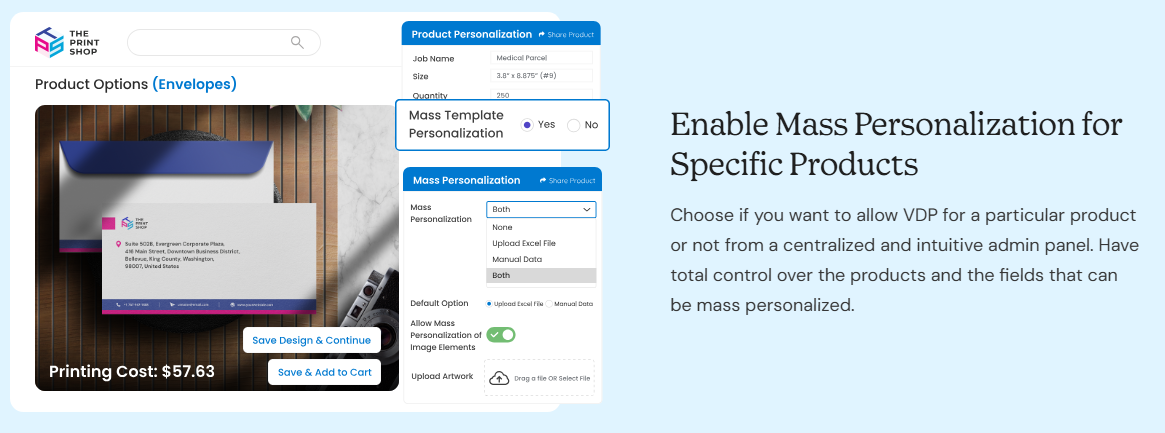
An ‘AI wrapper’ approach is emerging as platforms integrate AI as a middleware layer that enriches the data feeding the VDP engine. With this method, the AI handles audience segmentation, content selection logic, and copy variants while the legacy system handles the actual composition and output. “This extends the life of existing investments while adding intelligence upstream,” explains Naimish Patel, VP of sales, OnPrintShop.
It allows for AI-driven personalization without ripping and replacing a production workflow that already works. “Staff retraining is minimal. For print businesses that have spent years optimizing a particular platform, this is an attractive path,” adds Patel.
Another benefit is speed. “AI can generate and process variants quickly, which is valuable when a brand wants to tailor copy, imagery, or offers across many different audiences. It can also help marketers work with less rigid segmentation, moving from broader groups towards more targeted messaging,” adds DePauw.
The challenge is predictability. “In print, ‘almost right’ is not good enough. A layout that breaks at the point of output can be expensive, and margins are tight enough as it is. This is why AI-driven VDP should not be treated as a fully autonomous process. AI-generated content needs to be constrained by approved data fields, brand rules, compliance requirements, and production templates,” shares DePauw.
Patel admits that since legacy systems were not designed with AI inputs in mind, data handoffs can be messy. “APIs may not support the kind of dynamic field structures that modern AI-driven VDP wants to use.”
Further, governance questions may arise around who owns the data, where AI processing happens, and how client data is protected, adds Patel.
Longer term, Patel believes pure-play AI-native platforms will overtake the layered approach. But for the next few years, the AI wrapper model is pragmatic and commercially viable for most mid-market print businesses.
Aug2026, DPS Magazine