by Cassandra Balentine
Digital print and supporting technologies are inching their way into the packaging space, especially for prototyping and short runs. Common packaging applications printed and finished digitally include folding cartons, corrugated board, luxury packaging, and those that incorporate specialty materials. For any of these packaging products, finishing is essential.
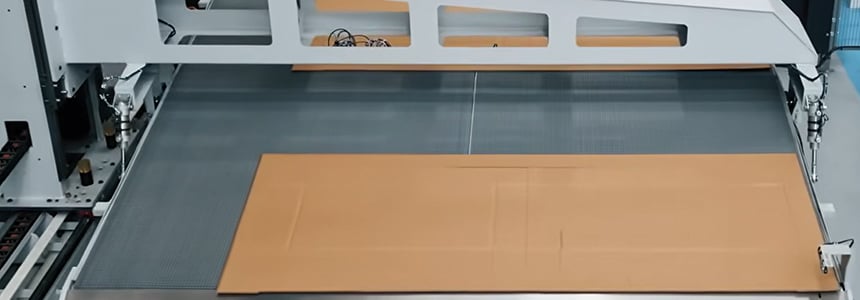
Above: Zünd’s range of cutting platforms help users maintain continuity, from concept development all the way through to industrial-scale production.
“As demand for shorter runs, faster turnaround, and more customized packaging continues across all of these areas, brands want to test packaging concepts before committing to larger production, and printers want the ability to say yes to more specialty work without the cost of outsourcing or purchasing traditional dies,” says Drew DiPirro, sales and marketing support, Graphic Whizard USA.
Quick turnarounds and short runs are here to stay, and David Newell, director of applications, Kongsberg Precision Cutting Systems, feels it is important to have the ability to produce packaging closer to demand in order to reduce inventory.
Martin Thornton, packaging business development manager, Zund America, Inc., agrees, adding that packaging development is much more agile. “Brands want to evaluate more concepts, more frequently, while also maintaining the ability to quickly transition into market testing or short-run production. As a result, there is growing demand for digital workflows that eliminate the traditional divide between structural design, prototyping, and manufacturing.”
Wendy Baker, UK marketing manager, Plockmatic Group, feels that the conversation around packaging has shifted decisively. “What was once a market built on long runs, dedicated tooling, and conventional die cutting is being challenged by a customer base demanding rapid turnaround, versioned products, and economically viable short runs—often in the hundreds or low thousands rather than the millions.”
Producing Prototypes
Digital cutting is particularly well suited to prototyping because it eliminates the need to manufacture expensive dies for every new design. Specific benefits include eliminated tooling costs, rapid design iterations, faster approval cycles, accurate representation of final production quality, and the ability to create highly customized, one-off samples.
Also, the use of digital files for cutting does not restrict the number of changes, “as it is a simple edit of a digital file to create new cutting templates and this can then be used to communicate directly with the cutter to use the specific tools required to produce the prototype or packaging,” says Terri Winstanley, marketing manager, packaging and labelling division, Plockmatic Group. “Designs can be modified instantly, allowing multiple iterations to be produced within minutes, reducing development time and material waste. The technology delivers production-quality prototypes with accurate cutting and creasing, enabling designers to validate fit, form, and function before committing to full production.”
“For prototyping, digital cutting is ideally suited for producing packaging samples, mockups, and design iterations quickly and accurately, making it the preferred solution for prototype development,” offers Thornton.
“Packaging designers can quickly create, test, and modify concepts within minutes or hours rather than days,” shares Matteo Muto, product manager, Summa. “This flexibility enables packaging developers to validate structural designs, graphics placement, material selection, and consumer experience before committing to production.”
“When brands request work, they often need it to be done and out the door as soon as possible, something that only digital cutting tables can enable,” comments Newell. “This is further achieved due to technologies such as camera systems and vision recognition software, which ensure that the first piece that is cut is a high-quality saleable sample, whereas legacy technology sometimes takes five to ten attempts to get one good sample. This minimizes approval time and facilitates quicker response to customer requests, contributing to quicker turnaround times.”
Speed and flexibility are essential. “A print provider can move from a digital design file to a finished sample without waiting for a physical die to be manufactured. This allows packaging designers, brand owners, and printers to test shapes, folds, materials, and structural concepts quickly,” offers DiPirro.
Thornton agrees, pointing out that systems using digital, computer-controlled knife cutting and routing technology are highly adaptable to any kind of production scenario.
More widely, Newell says digital cutting reduces production costs by enabling materials to be ordered when needed.
Muto sees few limitations in a prototyping environment. The primary consideration may be material compatibility or the need to replicate very specific production effects intended for high-volume converting equipment.
It is important to always ensure you’re utilizing the correct technology for the requirement. “For example, for organizations producing very high volumes of prototypes or requiring greater throughput, a more productive platform such as the Kongsberg C or Ultimate may be more appropriate,” says Newell.
DiPirro adds that each material and structure may require some testing to determine the best tool, blade, pressure, and speed settings.
Short-Run Territory
For short-run packaging, digital cutting provides the flexibility to switch quickly between jobs without lengthy setup processes. Thornton says it supports cost-effective production, rapid turnaround times, and consistent quality, even as order volumes, designs, or material requirements change.
“As brands increasingly demand versioning, personalization, and shorter product lifecycles, digital cutting has become a compelling solution for short-run packaging production,” comments Muto.
For short-run packaging, DiPirro explains that digital cutting helps eliminate the cost and lead time of traditional dies, which can be a major barrier for smaller quantities. “Runs around 2,500 pieces often require a balance between automation and flexibility. Automatic sheet feeding, barcode recognition, mark registration, and multi-tool capabilities allow print providers to produce short-run packaging efficiently while still handling frequent job changes, custom shapes, and versioned designs.”
Because digital cutting technology also facilitates better versioning, Newell says it enables cost-effective production of seasonal and promotional packaging. For print providers moving into packaging, Baker says the single biggest hurdle is rarely the printing itself. It is the mental and operational leap from a world of predictable, repeatable bulk to one of constant changeover. The good news is that the technology to dissolve that barrier has matured rapidly. “Over the past three to five years, the most significant workflow advancement has been the move to fully digital, tangential cutting and creasing—where a tool head follows a digital file rather than a physical die. The advantages for prototyping are clear—no tooling cost, no lead time, and the freedom to iterate a design on screen and produce a finished, folded sample within minutes. For short-run packaging, the same technology turns what would once have been loss-making work into profitable production, because every job carries the same low setup overhead regardless of quantity.”
Thornton admits that while run lengths increase and jobs become highly standardized, conventional die-cutting may offer greater economies of scale. “The crossover point depends on factors such as run length, design complexity, material, turnaround requirements, and the level of automation in place.”
Newell often sees a mix, where producers use digital cutting solutions as complementary technology alongside conventional die cutting. So, the digital cutting technology is used for shorter runs and immediate production, while conventional die cutting is being prepared for longer runs,” comments Newell.
Digital die-less cutting technology is ideally suited to short-run packaging, but for very high production volumes, Winstanley admits that conventional die cutting is generally more economical due to its higher throughput. “Production speed is lower than dedicated high-volume die-cutting equipment, and the range of materials, sheet sizes, and thicknesses is dependent on the machine model and tooling configuration. However, as the packaging industry continues to embrace more sustainable manufacturing practices, digital die-less cutting provides an environmentally responsible alternative by reducing tooling waste, minimizing material waste, enabling on-demand production, and lowering inventory requirements.”
Cut it Out
In today’s packaging market, speed, agility, and personalization are critical competitive advantages when it comes to finishing. “Digital cutting technology provides manufacturers with the flexibility needed to respond rapidly to changing customer demands while maintaining exceptional quality and efficiency,” concludes Muto.
Oct2026, DPS Magazine