by Melissa Donovan
For perfect binding, polyurethane reactive (PUR) tends to be the glue of choice for digitally printed output. However, like any technology, there are limitations. It also finds competition from binding methods that use ethylene vinyl acetate (EVA) adhesive.
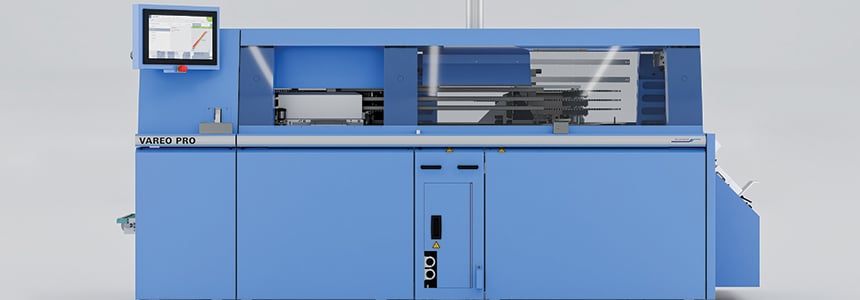
Above: The Müller Martini 3040 Vareo PRO binder produces up to 1,000 books per hour. 2. Standard Finishing’s Horizon BQ-500 Perfect Binder can reach production speeds of up to 800 books per hour.
“Perfect binding digitally printed books utilizing PUR adhesive has become the standard when it comes to offering the highest quality product no matter what the paper type or end use; as it delivers the greatest bind strength, the best layflat characteristics, and holds up well to all temperature extremes,” attests Mike Wing, senior solutions manager – book technology and digital solutions, Müller Martini Corp.
Kelly Miles, product specialist, Standard Finishing Systems, admits that “PUR’s bond strength is ideal for the variable nature of digitally printed output.”
It is preferred for high-end catalogs, corporate annual reports, textbooks, cookbooks, children’s books—or any product featuring heavy glossy page layouts and frequent handling.
Preferring PUR
PUR technology is top of mind for many print providers due to its ability to adhere well to challenging surfaces. EVA is another type of glue used for perfect binding digitally printed output.
“Both PUR and EVA hot melts are applied similarly in the perfect binder, however, PUR bound books require additional curing time prior to trimming or opening/using the finished product due to the extended cure time of this adhesive. PUR is typically preferred for digitally printed papers because it offers not only a very strong bind strength, but also a safety component in that it remains flexible and will not degrade over time or when exposed to higher ambient temperatures,” says Wing.
EVA is a thermoplastic ethylene vinyl acetate adhesive. It adheres to the surface of the paper being bound. “A clean smooth milling finish, as well as notching, is used on the spine to give a good surface area for the adhesive to contact. EVA adhesive melts upon being heated, and solidifies upon cooling in two hours or less to trimming and handling, and 24 hours to a near full cure time. EVA adhesive can be re-melted numerous times in binder tanks and gives a nice firm bind when cured,” explains Darryl A. Drever, senior proSUPPORT technician, Skandacor.
PUR on the other hand is a polyurethane reactive adhesive. “It binds by cross linking at the molecular level to the fibers in the paper to create a very strong, yet somewhat flexible bind that caters to a more layflat characteristic especially on larger or thicker books. For PUR, instead of notching, the spine of the book is prepared by shredding or fraying the paper of the spine to expose paper fibers that make contact with the PUR adhesive and can become an integrated part of the finished bind,” shares Drever.
In summary, PUR and EVA are both hot melt adhesives, but differ in how they cure. “PUR is a moisture curing adhesive. It draws humidity from the air and paper fibers, which triggers a chemical reaction that transforms the glue into an elastomeric film that cannot be re-melted. In contrast, traditional EVA cures as its temperature cools. It can be heated into liquid form, and then it re-solidifies when cooled,” explains Miles.
According to Ed Hudson, GM, Plockmatic Group UK, PUR is usually preferred because of its ability to adhere reliably to difficult stocks such as heavily coated, UV varnished, or tone rich surfaces—places where EVA struggles.
PUR also accomplishes a superior bind while using a thin layer of adhesive, notes Drever, one that finishes with a clean semi-translucent appearance.
PUR limitations include higher adhesive cost per kilo, the need for controlled humidity/temperature, and longer cure time compared with EVA.
Choose PUR
PUR adhesive is used for perfect binding digitally printed books due to its bond strength, flexibility, durability, and ability to adhere to challenging coated and digitally printed substrates. Despite its benefits, PUR does present challenges, namely longer curing times. As a result, EVA remains a practical option for applications requiring faster turnaround.
Advances in closed-loop nozzle systems, automation, workflow integration, and smart factory technologies help reduce traditional limitations of perfect binding while improving efficiency, consistency, and operator safety.
Oct2026, DPS Magazine