by Cassandra Balentine
Print management information systems (MIS) and enterprise resource planning (ERP) solutions have evolved far beyond their original intention of calculating estimates, creating job tickets, registering product data, and generating invoices. Today MIS and ERP manage business functions as well as help print companies make decisions, “faster, smarter, and more profitably,” suggests Dirk Deroo, CEO, Dataline.
While the historic functions of MIS/ERP remain essential, they are no longer sufficient. Tools like artificial intelligence (AI), automation, and real-time business intelligence transform their role from an administrative system into the strategic center of every modern print business.
Today’s print providers operate in a more complex environment than past generations, deal with shorter runs, faster turnaround times, increased customization, more production technologies, rising labor costs, volatile substrate prices, sustainability requirements, and growing customer expectations.
“This isn’t a temporary shift, it’s the new shape of the market,” admits Andrew Strand, business development manager for UK, Ireland, and Nordics, CERM. “Add an ongoing and growing labor shortage to that backdrop and the need for automation has never been greater—automating routine tasks, exchanging data between connected systems, capturing what’s happening on the shop floor in real time, and converting all of that into analytics to support confident, data-driven decisions.”
In this context, print MIS/ERP must become an operational intelligence layer that connects sales, estimating, planning, production, purchasing, logistics, finance, and management. “AI automation, connected data, and real-time analytics are turning print ERP into a business platform that not only registers what happens, but also helps companies decide what should happen next,” shares Deroo.
Considering Analytics
Modern print MIS/ERP are tasked with tracking machine costs and click charges to create essential analytics that help PSPs make real-time business decisions that affect profitability and production. “The objective is not simply to collect data. The objective is to transform data into better business decisions,” comments Deroo.
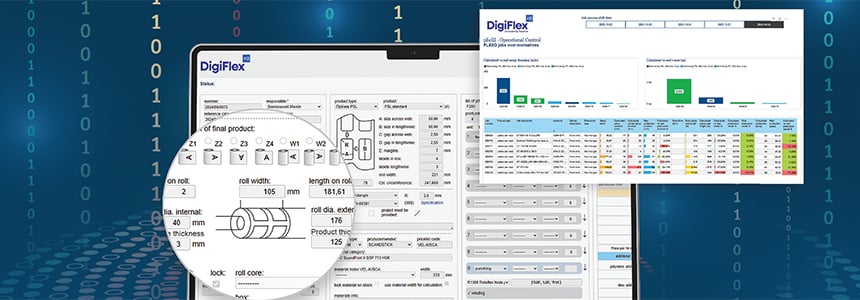
Through comprehensive reports, the Franklin Estimating team says modern MIS/ERP tools give users the ability to track actual time for each stage of a job, including machine up time, click charges, monthly costs, and depreciation, among other real-time data points.
“Analytics are now central to modern print ERP,” stresses Deroo, stating that for example, with Dataline systems, costs can be calculated and monitored through multiple models—hourly machine rates, click charges, lease costs, depreciation, maintenance, energy consumption, labor, setup, subcontracting, and material consumption.
For digital presses, click charges can be managed in detail, including tiered pricing, monochrome versus color clicks, press-specific click agreements, customer-specific contracts, and mixed pricing models on the same machine. For offset, large format, flexographic, and finishing equipment, the ERP tracks machine time, setup time, run speed, waste, labor, and material consumption, which Deroo says makes it possible to compare estimated costs with actual costs at job, machine, customer, and department level.
For MIS to provide support for modern digital printing pricing structures, Joseph Lehn, director of product management, PressWise by SmartSoft, sees the need to vary pricing based on the ink count as well as the quantity. “PressWise not only includes the ability to set click charges for black, four color, or two/three color by quantity, but it also allows the user to control press costing calculations based on the sheet size, number of colors, or type of substrate.”
Lee Ward, VP of product, CAI, says its Pace solution uses automated machine and process selection in its estimating engine and integrates with Auto-Count 4D for direct machine interface data collection, capturing real machine run time, clicks, and cost data straight off the press rather than relying on manual entry.
Tools like PrintVis support click cost calculations through its estimating setup. “Click charges can be defined either as item- or operation-based costs. These costs are included in the estimate and can later be compared with actual job costs,” offers Helle Vogt Mikkelsen, head of marketing and strategic partnerships, PrintVis.
With increased interest in specialized inks and toners, print providers may want to incorporate an upcharge per page or square inch for these colors/effects.
According to Lehn, when it comes to adding in special pricing for inks, toners, and embellishments, it’s important for the MIS/ERP to support pricing in a number of ways.
“Modern digital and hybrid production increasingly relies on white toner, clear toner, neon colors, metallic inks, varnishes, spot coatings, and embellishment effects. These are no longer exceptions; they have become part of the commercial value proposition of many print companies,” emphasizes Deroo.
To handle this variety of factors, solutions like PressWise support the addition of pricing to a job based on sheet size, area, count, perimeter, as well as many other calculation methods. “Flexibility in pricing is important with the diverse product lines that customers produce today,” adds Lehn.
Dataline ERP solutions allow companies to price these elements using production logic, including an additional charge per page, square inch, square meter, production pass, substrate, ink coverage, or finishing operation. “The system differentiates between standard CMYK production and specialized effects, ensuring that value-added applications are priced correctly and delivered with healthy margins,” explains Deroo.
Estimates in PrintVis are also flexible and can include different types of costs, such as special inks, coatings, varnishes, or additional color units, according to Vogt Mikkelsen.
Franklin Estimating’s team adds that most modern print MIS platforms support tiered click pricing and separate monochrome versus color click rates on the same digital press, though the flexibility and ease of modeling complex contracts varies by vendor and setup. “Our app does allow for monochrome versus color on the same machine and incorporates click charges. Though not tiered in the convention sense as it functions on a budgeted hourly rate.”
Actual Versus Projected
It is important to differentiate actual versus estimated job costing for today’s MIS and ERP. Over time, this improves estimating accuracy, pricing discipline, and operational efficiency.
Real-time production data collection is where Strand suggests estimated performance meets actual performance. “Comparing planned production against what really happened on the production floor.”
Printers and converters pursuing continuous improvement need answers to key questions that have an operational and commercial impact.
“Collecting this data accurately and consistently is critical,” says Strand. CERM offers several shop floor data collection methods matched to each converter’s equipment.
Dataline systems are designed to support actual production registration through barcode scanning, shop-floor data collection, operator terminals, mobile devices, JDF/JMF integration, and machine feedback where available.
After production, the system compares what was estimated with what actually happened. “This creates a continuous learning loop. If setup takes longer than expected, a machine performs below its standard speed, waste is higher than estimated, or if a customer consistently generates low-margin work, management can act on facts rather than assumptions,” adds Deroo.
On the shop floor, operators can clock in and out of jobs or machines, record production time, register material usage, report quantities produced, use touch-based interfaces, and scan barcodes to load job information.
Vogt Mikkelsen explains that this data is fed into the job costing system and compared with the original estimate. Companies can then see differences in labor, materials, and overall cost, as well as margins and profitability.
Pace’s integration with Auto-Count 4D lets operators log actual time and materials via barcode scanning and shop-floor terminals. “That real production data flows back into the job to reconcile against the original estimate, giving an accurate actual-versus-estimated comparison instead of a manual reconciliation process,” says Ward.
By reconciling Auto-Count 4D actuals against the original Pace estimate, shops get a true margin comparison at the job level, which can be rolled up by client or time period through reporting. Ward explains that this feedback loop shows where estimating assumptions are off and lets shops recalibrate pricing for similar future jobs instead of guessing.
Simplified Success
Today’s print providers and converters must find simplicity in complex workflows in order to remain profitable on more complex jobs that are shorter in length and expected faster.
The challenges are compounded with a shrinking pool of skilled operators. Modern MIS/ERP systems utilize analytics to measure returns, actual costs, and inventories.
Oct2026, DPS Magazine