by Cassandra Balentine
Security printing involves many options, some are visible (overt) and some happen behind the scenes (covert). While traditionally, overt and covert technologies are viewed as separate categories, in practice the strongest anti-counterfeit solutions often intentionally combine both.
Above: Rather than fitting neatly into either category, Scantrust’s Secure QR code sits in a category of its own, offering a feature that’s technically covert, but functionally overt thanks to the widespread usage of smartphones.
Overt features achieved with digital print include metallic effects, variable data/unique codes, color-shifting effects, microtext/fine details, holographic elements, tactical features, tamper-evident seals, UV/infrared responsive authentication technologies, enhanced phosphor technologies, laser marking/engraved identifiers, and encrypted barcodes.
“Overt features are directly perceptible without a special tool. Some are printed digitally, while others are supplied through specialty media, inks, labels, or finishing,” offers Chris Bilello, VP, business solutions development, Konica Minolta Business Solutions U.S.A., Inc.
Covert technologies cannot be seen by the naked eye and include invisible security inks and coatings, multi-factor authentication technologies, and various taggant technologies.
Covert techniques such as invisible UV/IR inks, digital watermarking, and hidden metallic layers are popular because they provide a second layer of security that is not easily detected or replicated. Applications include high-security documents like passports and diplomas, event tickets, and brand packaging for high-value goods.
“Their popularity stems from immediate, user-friendly authentication, which is important for government-issued IDs and certificates, trading cards and collectibles, gift cards, event tickets, luxury packaging, and brand protection,” notes Mark Geeves, co-founder, Color Logic.
Increasingly, authentication technologies incorporate both overt and covert characteristics. “For example, a technology may provide rapid field authentication through UV or infrared response while simultaneously incorporating proprietary microscopic or forensic-level identifiers that remain extremely difficult to replicate,” shares Kelly Jechorek, VP, business development, Microtrace, LLC.
The most effective anti-counterfeit programs are no longer built around a single security feature. They intentionally utilize multiple layers of authentication designed to address different threat levels and authentication requirements, agrees Jechorek.
Additionally, continued advancements in technology move the mark on how secure print functions are classified. “Overt and covert are useful terms, but they predate the widespread availability of mobile phone authentication. Overt has traditionally meant a feature verifiable by the human senses alone—no tool required, while covert has meant a feature that requires specialized equipment or training to check,” shares Dr. Justin Picard, CTO, Scantrust.
The smartphone changes that distinction. For example with Scantrust’s Secure quick response (QR) code the security feature itself isn’t visible to the naked eye, so it would traditionally count as covert. “But since almost everyone carries a smartphone capable of authenticating it, anyone can check it in seconds, with no training and no special reader needed. In practice, it acts like an overt feature while keeping all the security benefits of a covert one.”
Semi-covert features require a simple viewing aid or common reader, while covert features require a purpose-built reader, specialized knowledge, or forensic analysis. “Depending on the implementation, examples can include microtext checked under magnification, UV- or IR-responsive markings, machine-readable patterns, digital watermarks, hidden identifiers, and forensic or molecular taggants. MICR is a useful hybrid example—the standardized characters on a check are visible, while their magnetic signal is read by bank-processing equipment. Classification depends on how a feature is verified; the same general technology may be overt in one implementation and semi-covert or covert in another,” offers Bilello.
Some technologies may also change categories during an attempted reproduction. For example, an anti-copy pantograph or Konica Minolta bizhub Copy Protect pattern can be relatively unobtrusive on the original but become overt when the copy reveals warning text. “The strongest programs use multiple independent layers selected for the application, the value of the item, the anticipated threat and the verification process,” points out Bilello.
Growing Demand
There is a steady demand for security printing functions. Geeves sees a marked increase in demand for robust security printing in the digital print space, which is driven by the proliferation of counterfeit goods, shorter print runs, increased regulation, and consumer awareness.
Increased global counterfeiting activity, growth in ecommerce and third-party marketplaces, regulatory and traceability requirements, brand protection initiatives, greater supply chain visibility requirements, consumer expectations surrounding product authenticity, and the rapid adoption of smart device ecosystems, are also creating interest, according to Jechorek.
Picard sees demand growing particularly for products that benefit from putting authentication directly in the hands of consumers and end users. Brands and governments alike are moving away from security features that rely on trained inspectors or specialized equipment and toward solutions that anyone can use with a device they already own.
“What’s driving this shift comes down to end user usability. A smartphone-based authentication experience needs to be intuitive enough that a consumer can verify a product in seconds, without instructions or prior knowledge. The only requirement should be owning a smartphone, nothing more. As counterfeiting grows more sophisticated and consumers grow more conscious of product origin and authenticity, this kind of accessible, self-service verification is quickly becoming the standard that brands and regulators expect.
“Organizations seek stronger ways to protect brand reputation, consumer trust, sensitive information, and critical business processes while producing more personalized materials in shorter runs. Advances in scanning, imaging, and desktop production have also made basic visual imitation easier, increasing the value of features that support authentication and traceability,” shares Bilello.
Demand for printed security features is also driven by sector-specific regulatory requirements, fraud prevention, supply-chain risk, and the need to validate individual documents, labels, or packages. “Digital print is well suited to piece-level serialization and variable data. When a unique identifier is tied to a trusted back-end system it can support rapid verification, traceability, and status checking,” says Bilello.
Demand continues to grow across traditional and emerging applications. “Counterfeiters have access to sophisticated digital printing capabilities, making it easier to create convincing counterfeit products, packaging, and printed materials. At the same time, organizations demand stronger authentication capabilities throughout their supply chains and product ecosystems,” notes Jechorek.
The growth of smart device ecosystems is particularly exciting. “Increasingly, manufacturers are designing products in which a device must authenticate the consumable, component, or accessory before it can function. This evolution is creating entirely new authentication ecosystems that seamlessly connect physical products, authentication technologies, and connected devices,” states Jechorek.
Organizations are no longer satisfied with technologies that merely deter counterfeiting. “They want solutions that can definitively authenticate products throughout their lifecycle,” adds Jechorek.
Advancements and Products
While QR code-based authentication isn’t a new technology, Picard explains that it’s become widely recognized and adopted at scale in the past few years. “What’s changed isn’t the core concept, it’s the level of familiarity consumers now have with scanning a QR code, combined with improved smartphone camera quality. That shift has turned what was once a niche security feature into a widely accepted authentication standard, and it’s opened the door for brands and governments to roll the solution out at scale.”
As noted, a major advancement in security print is the convergence of physical security features with digital verification. “A printed item can carry a serialized two-dimensional code, digital watermark, or copy-detection pattern is tied to a trusted record. When properly implemented, the system can support item-level authentication, traceability, status checking, expiration, or revocation. A standard QR code by itself does not prevent copying; the security comes from serialization, the trusted back-end process and, where appropriate, an additional authentication feature,” offers Bilello.
Variable data workflows, automated production inspection, machine vision, and mobile verification have broadened the practical use of layered security. “On selected AccurioPress configurations, Konica Minolta publicly documents PDF/VT-2 variable printing that can change content such as a ticket serial code by recipient. Konica Minolta also documents automated inspection capabilities on certain production systems. Availability and performance depend on the press, controller, software, options, media, and workflow configuration,” explains Bilello.
Konica Minolta and TROY have also expanded production MICR capabilities. The TROY AccurioPrint 2100 MICR is positioned for entry-level centralized MICR production at up to 100 pages per minute (ppm), while the AccurioPress 6136P MICR provides 136 ppm for higher volume environments. Both use TROY MICR Toner Secure. The important distinction is that standard MICR supports machine readability and banking-process requirements, while MICR Toner Secure adds a separate tamper-evident response to attempted chemical alteration.
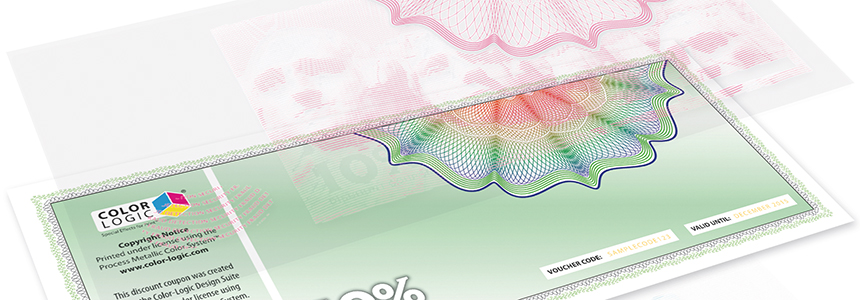
Color-Logic has introduced advanced algorithms for metallic color generation, enabling printers to produce thousands of secure metallic shades and patterns with just five colors (CMYK + metallic). Geeves says recent digital presses have expanded capabilities for white, silver, and clear inks/toners, opening new avenues for layered security features.
Jechorek sees an evolution of authentication technologies from standalone security features to integrated authentication platforms. “Historically, anti-counterfeit technologies focused on making products difficult to copy. Today, organizations want definitive answers about authenticity.”
This means knowing if a product is authentic; if it can be authenticated immediately, or anywhere in the world; if it supports supply chain visibility requirements; and if it integrates with connected devices and authentication systems.
“The future of security printing isn’t simply a better hologram or a more sophisticated invisible ink. It is the layered authentication platform behind them—overt and covert technologies working together with integrated authentication devices and connected authentication solutions,” comments Jechorek.
According to Jechorek, modern authentication technologies bridge the gap between physical security features and intelligent authentication ecosystems.
“The integration of digital workflows with specialty inks (e.g., fluorescent, UV, IR) and the ability to embed variable data in hidden layers are notable advancements. “Some presses now allow for simultaneous overt and covert feature printing in a single pass,” offers Geeves.
Securing the Printed Page
From certificates to credentials, permits, licenses, controlled forms, prescriptions, and checks, a variety of applications benefit from security features made possible by modern production print. These features often bring in more revenue per piece as well as deliver peace of mind to the brand or print buyer.
Nov2026, DPS Magazine