by Melissa Donovan
The features found on the newest inkjet production presses are a reflection of print providers’ highest priorities—efficiency, productivity, and profitability. Developments like real-time press monitoring, predictive maintenance, and/or self calibration tools address concerns about manual operator intervention. Advancements in ink chemistry, drying systems, and fluid management expand media compatibility while respecting environmental considerations.
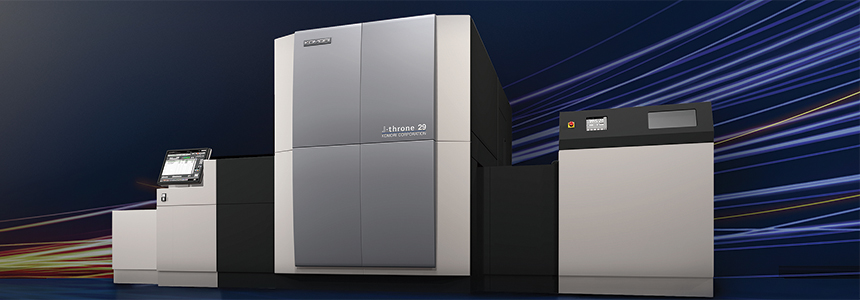
Above: Komori’s J-throne 29 LED-UV inkjet press is equipped with KP Connect. The system features real-time job monitoring and also sets up required maintenance for the machines. 1. Inkjet applications produced using Kodak presses.
Key to these updates are drivers like labor dynamics and the push for automation, a growing demand for personalization and shorter runs, as well as the increased introduction of environmental requirements.
“Printers are managing more jobs, shorter runs, and greater production complexity, often with fewer experienced operators. That makes productive uptime critical, and it is why we are focused on reducing routine operator intervention while giving production teams better visibility into quality, press health, and job status,” shares Barbara McManus, VP/GM, PageWide Industrial, HP.
“Skilled operator shortages across the global print industry accelerate the demand for automated self maintenance, self calibration, simplified user interfaces, and robotic material handling, creating a path toward ‘lights-out’ pressroom operations,” adds Lisa Weese, director, product strategy, production printing solutions, Canon U.S.A., Inc.
Pair this with “ease of use, ease of training, consistency of color from month to month, wide color gamuts, substrate compatibility, and high productivity” and inkjet is a great choice for any print facility, attests Lance Martin, VP product marketing, Komori Americas.
According to Brian Anderson, senior manager I, product management, Ricoh USA, Inc., production inkjet conversations often begin with speed, resolution, and media specifications. “Those measures matter, but they are not the final outcome a print provider is buying. The real objective is dependable capacity—the ability to move more work through the operation, respond faster to customers, and expand the range of applications that can be produced profitably.”
Brand owners continually request targeted advertising campaigns, recognizing their power with consumers. “High-speed production inkjet provides the agility needed to deliver cost-effective short runs, rapid job turnarounds, and haptic direct mail,” explains Weese.
Simultaneously, stringent environmental mandates make hardware updates on inkjet presses almost a necessity. “Escalating corporate sustainability requirements and regulatory standards are driving adoption of energy-efficient drying systems; non-toxic, water-based chemistries; and precise, drop-on-demand fluid management that minimizes liquid waste and conserves raw material,” adds Weese.
In Process
The latest developments in inkjet utilize tools like real-time press monitoring, predictive maintenance, and/or self calibration to reduce manual operator intervention and improve uptime.
Canon’s varioPRESS iV7 and varioPRINT iX1700 sheetfed platforms focus on high automation, precision, and minimizing operator intervention, according to Weese. Automated quality control is achieved with inline scanners and real-time nozzle activity algorithms to detect and compensate for clogged nozzles by adjusting droplet sizes or using alternate nozzles. Both printers also feature automated correction systems to help prevent white lines and streaks.
Advanced media handling features improve uptime. Both the Canon varioPRESS iV7 and varioPRINT iX1700 dynamically correct sheet timing and skew for precise front-to-back registration. Canon’s varioPRESS iV7 additionally features Sentry Control to detect deformed media, lift printhead bars to help limit damage, flush bad sheets, and automatically replace missing pages.
The webfed platforms in Canon’s portfolio, such as the ColorStream 8000 and ProStream Series, also offer features that aid in improving production timeliness. Weese points out that these continuous-feed platforms “emphasize uninterrupted uptime, dynamic self calibration, and flexible service frameworks.”
Examples of this include real-time calibration with Inline Image Quality control. This utilizes camera sensors to monitor color, alignment, and ink density. A dynamic self calibration, it eliminates manual target scans, test charts, and operator subjectivity without taking the Canon ColorStream 8000 or ProStream Series offline. It compensates for shifts or non-firing nozzles automatically. In terms of printhead preservation, technologies like PreFire continuously circulate ink to prevent drying, while automated web cleaners purge debris to help maintain optimal print conditions.
HP PageWide Web Presses have automated on-press ICC profiling, which reduces manual steps in color management while the HP vision system optimizes quality for each job. “Operators have a comprehensive view of press health and job status. Operator-replaceable printheads allow more maintenance tasks to be handled directly without requiring a technician for every intervention,” comments McManus.
Kodak focuses on making inkjet systems more intelligent, automated, and easier to operate. It leverages machine learning in production inkjet through technologies such as an automated color-to-color registration system, which continuously optimizes registration accuracy and maintains image quality with minimal operator intervention.
The latest developments from Kodak incorporate real-time system monitoring, preventative maintenance alerts, automated maintenance functions, and intelligent print controls that help identify potential issues before they impact production.
“Combined with enhancements in serviceability and startup performance, these capabilities reduce setup time and manual adjustments, improve consistency and reliability, and help customers maximize uptime while returning to production more quickly after maintenance events,” shares Josh Howard, senior director, inkjet R&D and engineering, Kodak.
Komori Americas addresses production monitoring and analyzing with its system KP Connect. It gathers information about the production of each job on a press, including the new J-throne 29 LED-UV inkjet press. The system features real-time job monitoring and also sets up required maintenance for the machines.
“Using the data and the charting comparisons in the report module, production departments can look deeply into each job and compare many facets. It is easy to see issues caused by a particular stock or other production-related processes and initiate improvement plans. If you can measure it, then you can control it,” explains Martin.
The RICOH Pro VC80000 is a high-volume, continuous-feed inkjet platform with on-press controls like real-time jet-out compensation to monitor printhead performance, inline color monitoring, and sensors that support color-to-color and front-to-back registration adjustments as the web moves through the press. “Together, these functions are intended to reduce avoidable intervention and make quality more repeatable across long runs, operators, and shifts,” shares Anderson.
Additional Updates
Advancements in ink chemistry, drying systems, and fluid management help expand media compatibility and reduce fluid and/or energy consumption.
Ink Chemistry
Formulated with proprietary water-based polymer pigments, Canon production inkjet inks form a protective resin film on the substrate surface upon impact. “This rapid immobilization helps to limit ink pigments from sinking into paper fibers and aid in delivering vibrant color density on standard offset coated and uncoated stocks from 40 to 300 gsm without requiring pretreated paper,” says Weese.
Kodak continues to advance its entire inkjet ecosystem, including inks, fluids, primers, and drying technologies. Water-based KODAK EKTACOLOR Inks utilize nano-particlate micromilled pigments and lower humectant levels, which improve drying efficiency, reduce fluid consumption, and support a broader range of substrates. Combined with KODAK OPTIMAX Primers and optimized drying systems, these technologies help customers achieve high-quality output on a variety of media while lowering waste and operating costs.
Komori’s LED-UV inkjet platform works with an ink set that allows for printing on a range of substrates. This includes papers, paperboards, and many synthetics, without the need for precoating or pretreatment. The ink allows a variety of stocks to be easily recycled.
Drying Systems
Canon tailors drying systems to the operational dynamics of each press series in order to optimize the technology’s thermal efficiency and media stability.
The Canon ProStream 3000 series features an asymmetric air flotation drying system that suspends web media on gentle cushions of heated air to dry heavy stocks at rapid production speeds.
The Canon varioPRINT iX3200 employs a hot air impingement system enhanced with humidification control to deliver dry, flat sheets.
For high-speed web printing, the Canon ColorStream 8000 series pairs heating saddles with active cooling modules to rapidly set high-coverage prints at speeds of up to 656 feet per minute while maintaining efficient power utilization.
The Canon varioPRINT iX1700 utilizes a multi-stage drying system featuring a hot air Drying Unit to eliminate moisture, a Fixing Belt Unit to bind ink into a solid film while keeping sheets flat, and passive conditioning designed to help seal out external humidity and minimize paper curl.
HP High Efficiency Dryers are modular so customers can scale drying capacity according to application and production needs, thereby reducing site power requirements and overall power usage, explains McManus.
Ricoh developed the Firefly drying system, found on the RICOH Pro VC80000. “The name ‘firefly’ was inspired by the distinctive way the system operates. Rather than running continuously, individual heat lamps cycle on and off, creating a flickering effect reminiscent of fireflies in motion,” explains Anderson.
Real-time temperature monitoring occurs at each roller throughout the drying process. By activating only the heat that is needed, when it is needed, the Firefly system maintains optimal drying performance while reducing overall energy consumption.
“Its compact spiral design creates a longer paper path, while the optimized layout and smaller heat drum support efficient drying and faster warm-up. These are engineering details, but their impact is operational—better control of drying can support heavier stocks, coated media, and stable output at production speeds,” says Anderson.
Fluid Management
Canon offers targeted fluid management via its ColorGrip technology, which is available on platforms like the varioPRINT iX3200. The technology allows for jetting micro-droplets of conditioning fluid exclusively where ink will land.
“This spot application is designed to support stabilization of pigments on offset papers, which aids in minimizing primer consumption, helps preserve natural paper haptics, and minimizes the fluid volume that must be evaporated,” shares Weese.
Ink, paper, and drying have to work as one system. McManus points out that a great ink does not solve the customer’s problem if it requires too much energy to dry or limits the papers they can run.
“For print providers, the opportunity is to reduce the compromises between ink chemistry, fluid management, media, and drying, giving them greater application flexibility while improving productivity, resource efficiency, and the economics of moving more work to inkjet,” adds McManus.
Driving Forward
Future advancements in inkjet production printing involve leveraging artificial intelligence (AI), a continued focus on sustainability, and pushing automation into all parts of the workflow.
“We expect to see more intelligent systems that leverage predictive diagnostics, automated quality control, and closed-loop process optimization,” suggests Howard.
Weese believes production environments are moving toward end-to-end operational intelligence utilizing technology such as AI.
Eco-friendly inks are also improved upon regularly and this will continue. “Next-generation water-based pigment inks and resin binder chemistries are being engineered to print seamlessly onto non-porous, synthetic, and recycled substrates without requiring chemical pretreatments,” shares Weese.
Environmental considerations beyond ink are also a topic, particularly in regards to minimizing waste. According to Howard, “advances in printheads, inks, and media handling will enable inkjet to address more packaging, commercial, and industrial applications. Ultimately, success will be measured not just by speed, but by the ability to produce more sellable output with less labor, waste, and downtime.”
Automation is occurring now, but an extension of this is robotics and autonomous mobile handling, which is expected to grow.
Weese sees press rooms evolving into interconnected smart factories. Autonomous Mobile Robots and Automated Guided Vehicles manage material logistics with Canon presses. “Managed directly through centralized press management software, these vehicles autonomously transport heavy paper rolls to webfed unwinders, deliver substrate pallets to sheetfed feeders, and move printed output directly to automated post-press finishing lines,” explains Weese.
These innovations all contribute to improved profitability. “Faster turnaround times can help capture more volume and meet demanding customer expectations, while operational efficiencies and reduced rework lower production costs. Together, these benefits create a clearer path to sustainable growth and stronger margins,” says Anderson.
Future of Print
The latest advancements in inkjet production presses reflect greater efficiency, productivity, and profitability.
“The future of production inkjet is bigger than the press. The next frontier is a connected production system that understands the job, maintains its production context, and coordinates work from submission and preparation through printing, finishing, and delivery,” says McManus. “As these environments become more connected, AI will help production teams move from reacting to problems to anticipating them. That includes detecting unusual press or quality conditions, improving inspection, recommending the next best action, and helping reroute or recover work when production does not proceed as planned. Over time, more routine decisions can be automated, while operators remain in control of exceptions and higher value production choices.”
McManus says this matters because the economics of print are changing. Providers are producing more jobs, shorter runs, and more personalized output, often with limited labor and little tolerance for waste or delay. They also need better traceability and more reliable information across presses, workflow systems, finishing equipment, and business applications.
“The winners in production inkjet will not simply have the fastest press. They will be the operations that can convert press capacity into predictable, finished output with fewer manual handoffs, faster recovery from exceptions, and greater confidence in every job,” adds McManus.
Innovations such as real-time press monitoring, predictive maintenance, and self-calibration as well as advances in ink chemistry, drying technology, and fluid management are creating the print room of tomorrow.
“The future of inkjet will be driven by greater automation, broader application capability, and higher productivity,” notes Howard.
The newest developments demonstrate how inkjet technology is continuing to evolve in order to meet the operational and sustainable demands of today’s print industry.
Nov2026, DPS Magazine