by Cassandra Balentine
Print providers can market eprocurement processes to win enterprise RFPs.
Ayelet Szabo-Melamed, VP, marketing, XMPie, warns against positioning PunchOut and SSO as technical features, instead position them as business enablers. “Enterprise buyers care less about the underlying technology and more about outcomes—compliance, security, procurement efficiency, spend visibility, and ease of buying.”
Lead with the integration story, not the print story, suggests Pablo Jaramillo, product manager, MarketDirect StoreFront, CAI Software. “Enterprise buyers already assume you can print. What they’re evaluating is whether you fit into their procurement stack without creating extra work for their AP and purchasing teams. Providers who can speak fluently about SSO, PunchOut, and approval workflows in the RFP response stand out immediately from those who only talk paper and turnaround.”
David Graves, CEO, Aleyant, says to discuss compliance and risk, not the feature list. “Enterprise procurement teams do not get excited about PunchOut for its own sake, they care that every order is traceable, every approval is enforced, and nothing depends on someone remembering to follow a manual process.”
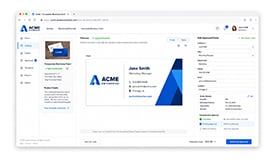
Dmitry Sevostyanov, CEO, Customer’s Canvas, suggests not marketing “cXML support” as the product. “Show the buyer that an employee can start inside the company’s procurement environment, personalize an approved print product, return it through the existing corporate approval process, and ultimately send the correct production artwork to the printer without manual re-entry.”
Enterprise buyers are purchasing the reliability and governance of that workflow, not the acronym behind it. Print providers should also show that they have a repeatable onboarding and integration approach. Sevostyanov says that reduces perceived implementation risk, which can be just as important in an RFP as the feature list itself.
“Print providers should demonstrate that they can fit seamlessly into existing enterprise workflows. The ability to support SSO, PunchOut, approval processes, procurement integration, and personalized ordering experiences can often be the factor that separates a supplier from competitors offering similar print capabilities. The providers most likely to win enterprise business over the next two years will be those that make themselves the easiest supplier to buy from,” comments Szabo-Melamed.
Don’t build integration capability speculatively. Build it against a named RFP requirement or an existing client’s stated roadmap—the failure mode is spending significant money on procurement-platform connectivity that never converts a deal. “Bring IT and procurement stakeholders into the conversation early, before the creative or production pitch, because integration requirements can disqualify a vendor at the RFP stage regardless of how strong the rest of the proposal is,” shares Alex Bowell, managing director, Infigo Software.
Sevostyanov generally advises against duplicating corporate procurement logic inside the personalization system. If the buyer’s procurement platform already knows who can spend $5,000, which cost center should be charged, and who must approve the purchase, the W2P layer should not become a second source of truth for the same rules.
It is also important to have a real answer ready for the technical due diligence questions, “specifically which ERPs you connect to, whether that connection is native or middleware, and how you handle exceptions when an order does not match an approval rule. RFP teams will ask, and a vague answer is often disqualifying on its own,” suggests Graves.
Read more on SSO adoption for W2P in the November issue feature, Easing EProcurement.
Dec2026, DPS Magazine