A Lesson in Labels

by Courtney Saba

As digital print technologies evolve, both label and packaging applications become viable. With digital printing capabilities, the possibilities for brand owners are seemingly endless, enabling variability and versioning, short runs, and faster turnarounds.

According to Smithers Pira’s The Future of Printed Labels Market to 2019 market study, the global market for printed labels was estimated at $32.7 billion in 2014, and is forecast to grow to $41.6 billion by 2019. The research indicates that while flexography is the most common print process in label production, digital methods are growing rapidly and taking an increasing share.

Both traditional converters and digital print providers look to the latest printing systems to enable innovation with efficiency and creativity. This article discusses the biggest opportunity for digital label adoption as well as hindrances like market education. In addition, we highlight differentiating feature sets of digital label systems on the market.

Market Opportunity
The opportunity for digital within the overall label production market is diverse in terms of verticals served, application types, and volume needs. Brian Cleary, category manager, Indigo Label Solutions, HP Graphics Solutions Business, shares that the digital label market is currently at around one billion dollars, and is projected to more than double by 2020.

Because the label market is one of the last to digitize, Michael Barry, product marketing manager, digital solutions, Fujifilm North America Corporation, Graphics Systems Division, believes it has a high growth potential in the next five years.

“We expect to see run lengths continue to decline, somewhere between seven to nine percent a year. We’ll also see continued proliferation in the number of SKUs. These two factors will drive digital print growth across almost all segments of the market,” predicts Mark Sullivan, label systems manager, Allen Datagraph Systems, Inc.

Filip Weymans, director segment marketing, Xeikon, sees two areas offering the biggest market opportunities. “First, high-quality label printing such as cosmetics, food, wines, and spirits. Second the continued success in the flexographic replacement market based on quality, economic gains, and flexibility.”

Target marketing and personalization excel within digital label printing. “I’m often surprised by some of the interesting print work our customers are able to produce,” says John Hennessy, senior business manager, Jetrion products, EFI. “It’s truly a case where creativity is driven by necessity.”

Cleary points out hyper customization as a major trend. “Brand products like Share a Coke, the Diet Coke Extraordinary Collection, customized Bud Light music festival cans, and the Lay’s Summer Days campaign all show a trend toward customized packages on the individual level.”

Sean Cummins, product manager, Screen Americas, sees opportunity in industrial labels, driven by the ability to have multiple levels of security visible and non-visible up to seven levels.

Barry says hybrid printing is starting to be highly adopted in the label world due to the increased abilities it offers.
In regard to volume, Christopher Howard, VP of strategic development, Durst Image Technology U.S., LLC, suggests that the strongest opportunity for digital label production is the medium run space, “where the margin level of digital production and coinciding print volume makes for an excellent business model.”

Challenges
As with all technology, early adopters face challenges. These hindrances include price points, technology knowledge, and difficult operations. Technical concerns aside, market education on digital label solutions is needed to gain traction.

“One of the biggest hindrances holding back adoption is the misconception about the true cost of labeling,” offers Cleary. “The cost per 1,000 labels is only the tip of the iceberg when it comes to the total cost of labeling. When label buyers understand the full cost, and how digital can reduce the total cost of labeling throughout a product’s lifecycle, they will make the switch to digital,” he asserts.

Cummins adds that digital knowledge know-how and digital sales knowledge are in demand. “Owners are holding back until they have proper sales and management.”

Julie Lopez, marketing manager, NeuraLabel, also sees education as a limiting factor for the adoption of digital label printing technology. “The want and the need have existed for a while, but technology and price point are just now catching up. It will take education to make people aware of the choices available in full-color on demand printing,” she says.

Particularly relevant to inkjet, Barry explains that many providers are still in the education process when it comes to inkjet technology. It has been widely used in other industries such as wide format, but is relatively new in the label world.
As buyer education continues to expand, finding the best solution to suit a print provider’s needs is becoming easier.
Juan Kim, CEO, Valloy, says the first time the company showed its ANY001 solution two years ago—a toner-based device that targets the entry- and mid-volume market—most people asked about price per label in comparison with analog solutions or high-end digital presses like HP Indigo. “Now people are better educated by consulting with many dealers of different products and they understand the unique benefit of the small digital solution itself. These people have specific needs—short runs, variable data, lack of space for stock, and fast delivery,” he explains.

In addition to buyer awareness, issues such as machine speeds, reliability, substrate compatibility, and operating costs hold back digital adoption.

Amber Miller, product manager, Primera, points out that consumable costs for digital presses are almost always more expensive than ink for a flexographic press. “You need to find customers that can actually benefit from a digital process. A good example is a customer who has hundreds of SKUs, doesn’t want to hold stock of all those different labels, yet insists on the best possible print quality.”

It is important to remember that printing presses are a long-term investment and generally enjoy a long operational lifecycle. Taylor Buckthorpe, director of marketing, Colordyne Technologies, says the biggest adoption hurdle is indecision and the perception many converters and brand owners have regarding the technology. “The flexographic/analog presses have been the industry standard for a very long time due to their reliability and capabilities for long run and lower production costs. This indecision is created due to the fact technology is constantly advancing year after year so companies are concerned about their investment in digital print.”

Hennessy adds that flexographic presses in label shops have been gracefully aging over the last 30 years. “They don’t wear out quickly and parts are still available. However, just because it still turns on and was paid off years ago, doesn’t mean it’s the most cost-effective way to produce narrow web print work,” he states, adding that the demand for shorter runs, faster delivery, and the drive to eliminate non-value added process steps are reframing the thinking of even conservative printers.

Digital Label System Round Up
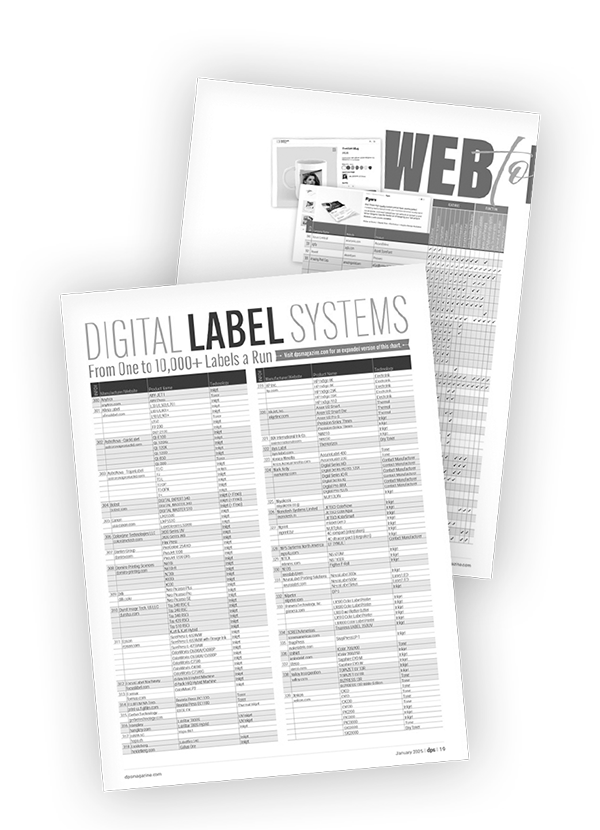
Here, companies offering digital label printing systems share information on their newest and most popular products.

Allen Datagraph Systems
Allen Datagraph Systems offers four different digital label printers. The iTechCentra HS printer targets mid-production environments and features LED toner technology. The iTech Cypher printer falls under the entry- to mid-level range category and is an inkjet solution. The iTech Spectrum printer features LED toner and is also suited for entry- to mid-level production environments. The iTech Talon printer is an entry-level production inkjet device.

Colordyne Technologies
Colordyne Technologies’ digital label printing products target industrial- and production-class label and tag applications. The 1600 series C is an entry-level device. The 2600 series mini press targets mid-range digital production. The 3600 series sprint targets high-level digital production environments.

Additionally, the products are engineered with the future in mind; an option that Buckthrope points out saves its clients’ money. “They don’t need to buy a new press when their work exceeds the capabilities of their current machine. The ability to upgrade our printing presses also creates a relationship with our clients that goes beyond the point of sale.”

Durst
The Durst Tau 330 series include 13-inch UV inkjet printers designed for short-run applications to high-volume print production. The 330 series features Durst’s HD print mode for high printing quality and runs at 157 linear feet per minute (fpm). The 330 platform can be configured with a number of options, including inline laser finishing, additional colors for gamut extension, low migration inks, jumbo unwind and rewind units for long production runs, as well as an open architecture that allows for third-party integration of pre- and post-finishing equipment.

EFI
EFI offers a portfolio of narrow-web UV and LED inkjet presses used in label, tag, and small signage printing operations. These products use EFI’s UV and LED print engines, inks, color management, and RIP technology to provide the lowest cost per print available.

The 4900M targets entry-level production and offers 8.3-inch wide printing at up to 80 fpm, while the 4900M-330 prints 13 inches wide, which the company says is a sweet spot for mid-volume producers.

EFI’s highest volume model, the 4950LX, features full LED curing of 13-inch wide prints at speeds up to 147 fpm.

Hennessy says all are inkjet powered and enable a range of off-the-shelf substrates to be printed.

Epson
Epson provides a series of digital label products under its ColorWorks and SurePress lines. The ColorWorks C7500 produces 50 fpm and up to 10,000 labels per day. It is water-based inkjet with an MSRP of $12,500.

The SurePress L-4033 allows 15 fpm and up to 30,000 labels per day. It is water-resin inkjet with an MSRP of $230,000. The SurePress L-6034 allows 50 fpm and 100,000 plus labels per day. It uses UV ink and is available at an MSRP of $650,000.

All Epson printers use Epson printheads and Epson inks. Michael Pruitt, product manager, Epson America, Inc., says the vertical design results in well-integrated and reliable products.

Fujifilm
The Graphium Digital UV Hybrid Press is an inkjet label production solution that targets the mid- to high-level printing environments.

Barry says the hybrid architecture of the press allows digital printing to be turned back into a manufacturing process with options for spot colors, varnishes, coatings, cold foiling, laminating, turnbars, die cutting, sheeting, and slitting. The digital print engine uses Fujifilm Uvijet ink that boasts excellent adhesion, rub-resistance, lightfastness, durability, and flexibility to be used on a range of flexographic substrates without the need for digitally coated materials.

HP
The HP Indigo WS6800 digital press offers improvements in automated color management via the inline color spectrophotometer. HP Indigo offers a range of color options, with seven ink stations allowing one- and two-color printing and three-, four-, six-, and seven-color process printing. The color separations are run in any order, and specific spot color inks can be mixed and run. The HP indigo WS6800 digital press is one of the most versatile narrow web digital presses in that it can run substrates from .5 to 18 points, covering applications such as prime labels, shrink sleeve labels, flexible packaging, and folding cartons.

Featuring a 30-inch wide web, the HP Indigo 20000 digital press targets mid- to high-end production web environments. Both utilize HP Indigo ElectroInk.

Konica Minolta
At Labelexpo 2015, Konica Minolta released its first full-digital label press system, filling the gap between entry-level and high-end digital label printing presses. The bizhub PRESS C71cf is ideal for profitable short to mid runs. It features easy operation, production flexibility, fast turnaround, and variable data printing functions.

Neuralabel Printing Solutions
The NeuraLabel 300x is an entry-, mid-, and high-production inkjet device with an MSRP of $4,995. It features HP PageWide Technology and offers print speeds of up to 100 fpm. It features pigment inks that are resistant to water, abrasion, saltwater immersion, and UV exposure. It allows high resolutions of up to 2,400×1,200 dpi, variable print width for labels of all sizes, and GHS and BS5609 compliant labels.

NeuraLabel 500e is an entry,- mid-, and high-production toner-based device with an MSRP of $8,995. It features print speeds of up to 50 pages per minute, high-capacity toner cartridges, print resolution up to 2,400 dpi, print width up to 48 inches, and GHS and BS5609 compliant labels.

OKI Data
OKI Data’s new C711DW digital web, roll-to-roll label printing system handles a variety of substrates including paper, polyester, and vinyl at widths of 6.5 to 8.5 inches in rolls and a maximum outside diameter of 14 inches. Finishing options include digital die cutting and lamination to deliver a complete, cost-effective, digital label print production system. The C711DW provides valuable revenue generating opportunities to the graphic arts.

Primera
Primera offers three inkjet color label printers. The LX400 and LX900 are entry-level solutions at $1,495 and $2,995 MSRP, respectively. The LX2000 Color Label printer is an inkjet device targeting entry/mid production environments, priced at an MSRP of $3,995.

The CX1200 Color Label press is a toner-based mid/high production level solution priced at an MSRP of $18,995.

Screen Americas
The L350 UV digital label press features piezoelectric UV inkjet and single-pass printing at four tones per drop. Targeting high-level production environments, the MSRP is $650,000.

According to Cummins, the solution has one of the smallest drop sizes—three picoliter, and four step grayscale. Other features include fully automated touchscreen operation and cleaning, as well as TRUST, the company’s preventative maintenance online technology.

Valloy
Valloy Incorporation offers the toner-based ANY002, which targets the entry and mid-volume market. It is a single-pass LED toner printer with an MSRP of $12,000.

The company also offers its TOPAZET UV 13R inkjet solution.

Xeikon
Xeikon presses are based on dry toner electrophotographic technology and offer true 1,200×3,600 dpi. Weymans notes the latest addition to the company’s portfolio is the CX3, which features speeds of up to 98 fpm and full rotary printing. The device offers all the benefits of the Xeikon 3000 Series, including the use of dry toners that meet FDA regulations for food contact and the ability to print opaque white toner in one pass. Additionally, the press offers easy integration of third-party workflow software, converting/finishing solutions, and incorporates professional color management capabilities. In addition to standard CMYK+White, the fifth station on the Xeikon CX3 can be used to print gamut expansion colors and security toner. Media weights range from 40 to 350 gsm.

Move to Digital
As digital label systems continue to evolve, both traditional converters and digital print providers look to capitalize on the opportunity. It is important for each business to evaluate their current and future needs and select a solution with the right feature sets and target volumes to best suit their demands.

“It is important to realize that no two print shops are the same—they differ widely in size, mix of print work, materials, in-house printing/converting, machinery, and have other operational differences to consider,” points out Hennessy.

From entry-level to high-end production, the market is ripe with options. dps

Mar2016, DPS Magazine

Third Anniversary Event

By DPS Staff

Canon Solutions America invited over 40 industry analysts and reporters to its third annual anniversary event this February 22 to 24, 2016 in Boca Raton, FL. Held at the Boca Raton Resort & Club: A Waldorf Astoria Resort, guests enjoyed a spectacular beachfront venue while company executives recapped the company’s progress over the past three years and were briefed on new products and services slated for the coming year. Presentations were grouped within Canon Solutions America’s main market segments, including technical services, professional services, enterprise services and solutions, production print solutions (PPS), and large format solutions (LFS).

“This event is very important to our company and each year further solidifies our relationship with our valued customers and members of the media,” says Toyo Kuwamura, president/CEO, Canon Solutions America.

Analyst firm InfoTrends reported on the company’s recent success. It positions Canon Solutions America as number one in toner/CAD/GIS in the last year, growing market share in 2015. In 2016, the company expects to continue growth in this segment due to new CAD color products. In 2015, the company’s UV flatbed market share grew from 19 to 24 percent.

2015 PPS revenue grew over 2014 and achieved 112 percent of goal. PPS had a productive 2015—introducing the Designers’ Guide to Inkjet, the thINK user group, and successfully launched the Océ VarioPrint i300. The company reports that its customers printed 79.9B pages in 2015.

Within PPS, announcements surrounded the Océ VarioPrint i300. At the event, Canon Solutions America highlighted new finishing options—the BLM600 booklet maker and the Tecnau TC 1530, which dynamically crafts horizontal and vertical micro-perforations. Additionally, the Océ VarioPrint i300 is fitted with a new ink set. Providing improved color gamut on treated stocks that is formulated to work with ColorGrip. ColorGrip enhances images’ quality on commodity grade untreated stocks. ColorGrip pretreats untreated stock with spot application utilizing one of six channels in the Océ VarioPrint i300. The news inks along with ColorGrip technology expand Canon Solutions America’s reach into the graphic arts and to commercial printers that traditionally dismissed inkjet as a viable alternative to offset and toner-based hardware.

In the PPS space, Canon Solutions America sees monochrome transitioning to inkjet. At the event it showcased the Océ ColorStream Mono, based on the Océ ColorStream 3000 Z’s compact design. The unit outputs 417 feet per minute and is available in dye or pigment, MICR compatible, with a total cost of ownership less than toner. The Océ VarioStream 4000 was also discussed. It is ideal for light weight and heavy weight offset coated papers. It boasts new controller functionalities.

Predictions in the LFS space for 2016 include new Océ Arizona models following the Océ Arizona 1200 launch in January to replace the Océ Arizona 400. It also plans to continue adding d.gen soft signage printers to its portfolio through its partnership with Media One Digital Imaging Solutions.

According to Kuwamura, the company was delighted with the outcome of the third anniversary event. “This year’s event was a reflection of our commitment to creating experiences that showcase the full breadth and scope of Canon’s vision. On behalf of Canon Solutions America, we are thankful to all who joined in our celebration of three years as a unified company.” dps

Mar2016, DPS Magazine

Raising the Bar

By Cassandra Balentine

In addition to the value digital print capabilities are known to provide—cost-effective short runs, variable data, and faster turnaround times—the latest print enhancement technologies add value and another layer to the possibilities of digital print.

In the last issue of DPS, we investigated several technologies that bring dimensional effects to digitally printed output. This week, we profile three print providers that invested in the technology to get an edge over the competition.

Presentation Folder
Established in 1977 as a letterpress shop, today Presentation Folder, Inc. operates one 70,000 square foot facility and employs a staff of 50. While the print provider serves a nationwide audience, it focuses on the Western U.S., specifically CA, and is headquartered in Orange, CA.

Joel Tardie, chief innovation officer, Presentation Folder, explains that the company operates with two core business models. The first is trade finishing for local printers, offering services such as spot and flood UV coating, digital raised spot UV coating, foil stamping, embossing, die cutting, and converting. The second is the production and sale of complete printed products, primarily presentation folders.

Using a combination of experience, skill, and the latest in digital print and finishing equipment, the company provides a range of high-value printing and finishing to both sides of its client base. A diverse range of printing and especially finishing equipment allows for a variety of specialty offerings.

For in-house digital production, the company relies on an HP Indigo 5600 digital production press, which offers many attractive features such as the ability to print on synthetics and high productivity of up to two million color or five million monochrome pages per month, producing color jobs at speeds of up to 90 pages per minute. Enabled by HP Indigo’s liquid ElectroInk technology and digital offset process, the device supports up to seven on-press ink stations. Targeting high-volume jobs, it includes white ink capabilities to create high-value, high-impact commercial applications.

In addition, the print provider’s finishing offerings include state-of-the-art features attractive to its network of trade customers. Conventional finishing equipment, including UV spot coating, embossing, and foiling, is often utilized as well as an offline roller coater and many lamination machines for digital finishing needs.

One device that helps set Presentation Folder apart from the competition is the Scodix Ultra Pro, which enables enhanced digital print features. With this equipment, the print and finishing services provider offers digital raised 3D UV effects that make its folders stand out. The product enables a high gloss, raised 3D look and feel that is comparable to embossing. Variable densities from one to 100 percent allow different levels of height and gloss to achieve tactile effects.

Presentation Folder invested and installed the Scodix Ultra Pro in the Fall of 2014. “We might enhance five percent of our jobs with Scodix,” estimates Tardie. “We use it on substrates from both offset and digital presses. We have even used it on large format printed sheets.”

The Scodix Ultra Digital Presses enable the production of tangible enhancements for a variety of applications including marketing literature, stationery items, book covers, boxes and premium packages, greeting cards, and photo albums with variable data capabilities based on a barcode system.

For Presentation Folder, enhancement work often includes logos and photos. Tardie says the shop enhances photos elaborately with Scodix because of the device’s ability to create sculpted, 3D effects with different levels and densities of the polymer. “Our primary product is a presentation folder, but we have done many types of digitally printed pieces from business cards to flyers, book covers, invitations, postcards, and packaging,” he offers.

The print provider recently accepted a job through a broker for a major golf company that wanted to create a package for its sales representatives to take on meetings to showcase the range of balls they offer. The package included a series of cards designed to emulate the actual boxes of different golf balls. The boxes themselves were printed on a metallic board stock using a UV offset press. To recreate the look, Presentation Folder used a metallic board stock and digitally printed them with white ink and CMYK on the HP Indigo. Then, the Scodix was used to emulate the embossing portion of the golf ball boxes.

Tardie says the decision to print digitally on the HP Indigo was easy because the client only needed 200 or so copies of each version. A similar conclusion was drawn for the embossing. Digital was the way to go for both convenience and savings for these short runs.

In addition to the cards inside of the package, Presentation Folder created the box. These were also digitally printed and then soft-touch laminated. Finally, they enhanced around the logo and overall blind pattern in the background using the Scodix. “The boxes themselves didn’t come with much direction,” recalls Tardie. “The client basically asked us if we could come up with a box to hold the cards. They didn’t call for Scodix either, but knowing we wanted a high-end look and feel, we thought we may as well try to see what we could come up with.”

The Scodix was used at 100 percent height/gloss for the logo, and the background pattern was ten percent density for a subtle satin effect. “The client loved it, and was happy to pay more for the Scodix on it,” says Tardie. “The nature of the digital process allowed us to show the client press proofs/prototypes on the actual stock, which ultimately helped convince them to upgrade and add the Scodix enhancement.”

The use of digital enhancement technology was useful for a couple of reasons on this job. First, Tardie notes that it was much more cost effective than embossing or doing a conventional spot UV. Second, it allowed the flexibility to get the job done faster, which was critical for this particular project. “As for the box itself, it definitely added excitement to a plain B&W print and was pretty much the only graphic on the box besides the logo,” offers Tardie. “Printing digitally also was very helpful in proofing as we were able to easily send one-off press proofs to the client to get the color as close as possible to UV offset printed boxes.”

The project took a couple of weeks to turn around, but Tardie says this was mainly due to artwork revisions. He estimates the actual production was closer to five to seven working days.

In the future, the company is interested in adding the foil attachment to its Scodix, but it’s not an immediate need as the shop still does well with its traditional foil stamping and embossing presses. The company is also considering a digital die-cutting option for short runs, and prototypes of custom die-cut pieces, especially packaging.

Kelvyn Press
Established in 1968 as a commercial printer and literature distribution service provider, Kelvyn Press Incorporated focused on the Chicago, IL financial services marketplace. The company expanded in 1998, and Financial Graphic Service (FGS) became the parent company, with a primary function of supporting financial services and insurance clients with their printing, production of annual reports, prospectuses, typesetting, and EDGAR filings.

The company operates three locations, including its 80,000 square foot headquarters in Broadview, IL; a 230,000 square foot fulfillment location in Naperville, IL; and a third 50,000 square foot facility in Braintree, MA.
In addition to its financial focus through FGS, Kelvyn Press specializes in corporate marketing and sales literature, direct mail, business to business communications, and promotional print. Services include traditional and digital print capabilities, a complete bindery, and mailing.

Among its digital offerings, the shop invested in MGI technology in 2014 as part of its digital print department, purchasing both the Meteor DP8700XL+ Press and the JETvarnish 3D Spot UV Coater and iFOIL integrated finishing suite.

The JETvarnish 3D features increased throughput for flat spot UV jobs and 3D raised effects. Tony Malacina, director of operations, Kelvyn Press, says he was drawn to the Meteor DP8700 due to its quality level and sheet size. “I’ve never seen digital equipment produce such high quality,” he states.

While investigating the Meteor DP8700, Malacina recalls the JETvarnish 3D and iFOIL integrated finishing suite. Realizing the industry was headed in the digital direction, he knew it was important for the business to transition itself as well. He envisioned the MGI JETvarnish 3D and iFOIL finishing solutions opening a new segment of business opportunities.
“We had a lot of clients doing small runs that wanted aqueous coating and crystal clear UV. To achieve this, we had to send the jobs out to be screen printed,” he explains. When Malacina noticed the capabilities of the JETvarnish 3D, he knew it could help eliminate outsourcing.

Since the investment in these technologies, the print provider has expanded its offerings, producing brochures, catalogs, invitations, envelopes, business cards, and books with enhanced print capabilities. The prototype options of the JETvarnish 3D and iFOIL allow the shop to experiment. He says there are many foil, color, texture, and substrate options to choose from and customers appreciate the variations of 2D spot coats, 3D enhanced textures, and embossed foil coloring.

Malacina finds that selling customers on the benefits of its digital enhancement technology is a rather easy feat. The company prepares before and after samples of client work to highlight the impact and enhancements of the JETvarnish 3D and iFOIL products.
In fact, he provides an example that hits close to home. “My wife is an author. She was printing her books and covers with a Web-based company. I begged her to give me a shot at the business, and when she finally set me up with one of her books, I did a couple of test copies using the MGI technology,” says Malacina. Once his versions were ready, using raised UV and foil, they put it next to her other copies from the previous print provider. “She’s already seen a 20 percent increase in revenue.” Since the test run, his wife has moved all of her book production to Kelvyn Press, which includes five novels and a novella.
The print provider also teamed up with Susan Hampton to publish her first book of poetry. Titled Heaven’s Pen: Heaven Whispers & So I Write, the book was printed on the MGI Meteor DP8700XL+ Digital Press and the cover was enhanced on the shop’s MGI JETvarnish 3D and iFOIL print finishing system with embossed foiling and spot UV textures.

The first run of the book incorporated spot UV coating, which was applied to the cover by the MGI JETvarnish 3D to highlight the design. However, Kelvyn Press decided that embossed silver foil details and text would make the design even more noticeable, and the team was able to quickly make the changes.

As digital continues to grow, Malacina is considering adding another Meteor press. He says he hasn’t even scratched the surface on what he can do with his print enhancement capabilities.

Fresh Color Press
Making its debut in 2003, Fresh Color Press is located in Eden Prairie, MN with two locations set a few blocks apart from one another. Between the two locations, it has 24,000 square feet of operating space and 22 employees.

The shop’s focus is creating high-quality digitally printed marketing collateral and direct mail products, serving primarily the Twin Cities area. However, the company also has clients throughout the Upper Midwest and a handful in other parts of the country.

A 100 percent digital shop, the company has operated Kodak NexPress production printing equipment since its start. It also offers large format display printing, which was introduced in 2011.

One of the features the shop appreciates about the NexPress is the Dimensional Clear Dry Ink offering for the fifth imaging station. According to Kodak, the feature consists of a dry ink that creates a clear “raised” layer on top of a page element after fusing. It can be used to enhance graphics, text, or a full-color image. The overall tactile effect is similar to thermography, but with a greater degree of control—the dimensional coating can be set to produce variable heights, so users can mimic the texture of a specific image.

When the option was introduced, the shop was already running three NexPresses and immediately ordered the upgrade. Today, approximately ten percent of the NexPress revenue for the print provider utilizes Dimensional Clear Dry Ink. Brian Johnson, president, Fresh Color Press, says the company made the decision to upgrade to this capability because they thought there would be market desire for dimensional printing.

In addition to dimensional coating, the shop also takes advantage of other fifth imaging unit options.

Johnson says the next big thing for the company would be investing in the next generation of the NexPress platform when it is available.

Setting New Standards
With digital print enhancement capabilities that feature high-gloss and embossing effects, print providers offer clients visually appealing graphics with a tactile advantage. dps

Mar2016, DPS Magazine