Year in Review

By DPS Staff

Each year we reflect on the culmination of emerging technologies and what it means for both the immediate and future print industry. As consumers become accustom to targeted messaging, the demand for relevant communications continues to rise. The move to digital print is rapid, and it’s a lot to take in. To help summarize noteworthy advancements, we’ve asked industry analysts to highlight key trends in their areas of expertise.

Above: Rethink CCM ltd. is an England-based PSP that created an interactive campaign for MyKeys featuring QR codes.

I.T. Strategies
Mark Hanley, president
The last 12 months in production and industrial digital print stand out for us at I.T. Strategies as a year of steady continuing growth in display graphics, labels, textile printing, and production inkjet—including transactional and book printing. Following drupa, packaging markets began to take digital printing seriously. Significant parts of these markets may become the biggest and most valuable for digital print. Flexible packaging in our opinion has the biggest potential, followed by corrugated print, and then folding carton—in that order.

In the flexible packaging market the HP Indigo 20000 continuous-feed, generation-four technology of HP ElectroInk has caught the imagination of converters with a hundred now in the global installed base, and with respectable print volumes. Yes, it is experimentation for the most part. The flexible sector—distinct from corrugated and folding carton—is technologically aware, and seems to particularly like the relative neutrality of toner chemistry in their food-driven world. Some early adopters have taken digital print direct to well-funded, brand-owner driven social media campaigns with real-time feedback to print. It is not going to grow exponentially as a market for some time, but a start has truly been made. Additionally it has sparked experimentation with aqueous inkjet, which a lot of the converters would like to see establish itself.

Corrugated digital print also made a big splash in the last year with some of the earliest systems from vendors like Durst, EFI, and HP hitting the market. This is of special interest since different inkjet technologies are being proposed at high production specifications and in quite distinct formats of pre and post print. The corrugated manufacturers have a real, strategic interest in digital. They see its potential to cut print costs and rationalize parts of their large supply chain. For example, picture Amazon printing its own boxes. This is an important and interesting testing ground for inkjet technologies.

Production aqueous inkjet has been applied to transactional and book markets over the last ten years, both segments are mostly monochrome and low coverage on uncoated papers. That market moves ahead, but is showing some signs of exhausting itself while needing to turn to higher value coated paper, graphics-type applications. That has begun, but not soon enough for vendors and users alike. Issues around print consistency on standard coated papers and around economics are still being defined rather than consistently resolved. It is difficult and it will surely find a resolution, but nothing in production digital print technology is ever fast or easy.

This brings us full circle to new technologies. Landa Corporation held an inaugural customer day around its first beta placement at folding carton converter, Bezalel, in Israel this Fall. What will we be saying about that in another 12 months? We don’t know, but at last there will be something to say from the actual market.

Keypoint Intelligence
Ron Gilboa, group director
Despite being eight years into an economic expansion cycle, many print service providers (PSPs) struggle to grow and continue to face challenges from displacement of print by digital advertising and workflows; emergence of high-speed, high-quality inkjet presses impact toner and offset presses; and convergence of service providers seeking growth from other applications.

Keypoint Intelligence believes PSPs need to focus on three value vectors to achieve revenue growth and profitability. The first vector is cost reduction. Some view this as a race to the bottom that can never be won, and the reality is there will always be a cheaper, hungrier, or more efficient PSP out there. The key is not to be the least expensive, but to be price competitive particularly in this age of procurement-led print purchasing and easy price shopping among internet-based PSPs.

Along the cost vector, printers must continually reduce costs for paper, ink, equipment, and labor. While negotiating better prices from suppliers may help, we recommend printers focus on workflow automation and machine productivity. Getting jobs into and through your shop with fewer hands touching them requires an ongoing commitment to process re-engineering and investment in software and training. Improving uptime and press utilization requires a more data-driven approach. Closely examine new high-speed inkjet presses with an eye towards shifting jobs from traditional toner and offset presses.

Ultimately, much of the printing industry is headed towards complete factory and supply chain automation.

The second value vector is what we call message and content. Here the focus is on making the printed piece more effective and creating a competitive differentiation. It may involve premium papers that can evoke emotion and draw in a reader; higher quality print achieved from better consistency, deeper saturation, higher contrast, or other desired features; or enhancements like foils, special colors, embossing, and die cuts. Significant advances within digital print enhancements are coming from companies including Duplo, MGI, Highcon, and Scodix, and we expect more to emerge.

Printers can use data to make a printed piece more relevant, timely, and personal. Combining these elements of premium paper, higher quality, print enhancements, and data can create some of the most effective printed pieces. The challenge for many printers is properly marketing and selling the value. Invest in sales training, samples, case studies, and other tools to show your customers how a well-designed printed piece can stand out and help achieve overall company objectives.

The last vector is connecting. This is about enabling market access for industry participants and facilitating a more efficient match of industry supply and customer demand. We are talking about creating or participating in a platform business that connects producers with other participants and ultimately to end customers. Most people regularly use platform-based services such as Airbnb, Amazon.com, Google, Facebook, Shopify, and Uber. Many similar platform-based businesses exist in the printing industry. Platform-based businesses have distinct advantages in reach, scale, and market disruption.

While creating your own platform can be highly profitable, most PSPs do not have the management vision and execution skills to successfully develop one. However, you can plug into an established platform to generate new revenue streams and build your knowledge base for the future.

These vectors illustrate trends emerging from the industry forecasts conducted by Keypoint Intelligence. We foresee digital printing growth in the print on demand space where two dominant technologies make up the printed output, namely electrophotographic (EP) and inkjet, which combined account for 39 billion M2. EP will be declining by a two percent compound annual growth rate (CAGR) from 2016 to 2021 to reach about 24 billion M2 in 2021 whilst inkjet will be growing at 15 percent for the same period to double its annual print volume to over 15 billion M2 by 2021.

Ongoing improvements in inkjet technology such as ink and media interaction, productivity, quality, and reduction in total cost of ownership are key drivers in adoption. From mid-range products to a new class of B1 presses all coupled with workflow automation such as job on boarding, calibration, quality control, as well as improved finishing and embellishment technology continues to drive adoption and page volume.

In packaging, a range of mega trends drive digital printing adoption in all fronts. The relentless need by brand owners to reach new demographics is driving the need for mass customization, which in turn becomes growth in SKU or the number of products that are available for purchase online or in the brick and mortar shops. Digital print is growing in all segments including label printing, folding cartons, flexible packaging, corrugated printing, and direct to shape. Though some are in the early stages, the Keypoint Intelligence 2016 to 2021 forecast is indicating continued growth in print volume to the tune of about two billion M2. With corrugated printing at 42 percent, label printing 34 percent, folding cartons 12 percent, and flexible packaging ten percent of the total print volume. These are anchored in continued investments in EP technology, which represents most of print volume today in labels and flexible packaging, as well as explosive growth in single-pass inkjet technology in sheet fed as well as web-fed presses for folding cartons and corrugated boxes.

The printing industry continues to evolve and will likely contract in the number of PSPs over the coming years. We expect the most successful companies to be the ones that will push down the value vectors and create cost advantages, improvements in the effectiveness of the printed piece, and new platforms such as digital print, workflow, and automation for better matching supply and demand.

Madison Advisors
Dave Erwin, director, technology practice and principal analyst
2017 was a time of transformation for our industry in several significant ways. Enterprise businesses were challenged more than ever to keep pace with evolving customer expectations for consistent, high-quality customer experiences (CX) during every interaction, whether it originates from the company or from the customer. One observation worth mentioning is many enterprises continue to only focus on outbound customer communications management (CCM) with little attention paid to inbound communications. As a result, those enterprises are missing opportunities to provide positive, high-quality customer experiences. Understanding that communication can and should always be a two-way medium that includes outbound and inbound communications, enterprises will go far in changing the CX landscape.

From the production side, we learned of enterprises recognizing significant and distinctive advantages by incorporating automation for the management of both inbound and outbound communications. Some enterprises have gone as far as employing Robotic Process Automation (RPA), a process of utilizing barcodes, glyphs, and other document features on their outbound communications to subsequently process transactions, manipulate data, trigger follow up responses, or communicate with other internal digital systems—all from scanning the inbound communication. Examples include automated payment processing, messaging back to customers to indicate information that is needed is missing, as well as to enhance operational efficiencies when inbound communications are returned, such as not submitting to case management for further processing until it is in good order. RPA is also used to extract data from external databases to gather required information about customers that will dramatically speed overall transaction processing or similar case management workflows.

Another development in the world of CX is the availability of innovative, web-based features within CCM software. Customer journey mapping tools are replacing traditional whiteboard or sticky note approaches; preference management solutions ensure communications are using the right channel and are sent at the optimum time; and of course, interactive web portals that give the business user more control over communication composition and management process without having to rely on IT resources. These users understand the context of the documents they are working with, so giving them control over the document creation process simply makes sense.

While still in the early stages of adoption by PSPs, we are seeing some start to leverage a web-based CCM hosted managed services model to give more control over document composition to the enterprise. With significant commoditization already taking place with respect to the production and mailing functions, offering customers value-added hosted services that allow control over composition represents a potential new source of revenue.

Finally, a significant amount of technological advancement in CCM capabilities was realized over the past 12 to 24 months. CCM solutions have become more affordable, feature rich, and user friendly and enterprises are faced with the prospect of modernizing their existing CCM capabilities or investing in an entirely new platform to gain more robust capabilities to keep up with the competition and with consumer expectations.

Undoubtedly, 2017 has been a year of change and evolution in this market space and we look forward to seeing these trends take deeper root in 2018.

Smithers Pira
John Nelson, commissioning editor
Across 2017 we have seen all participants adjusting to the new vision of the global print industry unveiled at drupa 2016.

Worldwide across all applications there is moderate growth in market value—1.5 percent, and print volumes remain fairly static. Diving slightly deeper, one can see that the expansion happening is favoring digital production over analog—and within this 2017 has seen the total value of inkjet work overtake EP/toner presses for the first time.

The largest growth segment across the next five years will be in packaging print, with many press builders now beta testing and selling higher productivity equipment targeting specific substrate types. The Smithers Pira study, The Future of Digital Print for Packaging to 2022, charts how in 2017 about 3.2 percent of the total packaging print market by value was on digital.

Annual growth rate for digital systems in packaging print will be 11.5 percent—by value—across the next five years. New business opportunities will be especially strong in the corrugated board and folding carton markets. These will both see annual expansion at around 25 percent for 2017 to 2022, and represent a strategic target for several equipment suppliers.

This will push a combined market value for labels and packaging worth $13.39 billion in 2017 to $23.08 billion in 2022 driven by systems for non-label substrates seeking to emulate the success digital has achieved with label printers.

Landa is targeting folding cartons with its S10, the market entry for its Nanography inkjet technology. In 2017, the mainstream corrugated sector has shown demonstrable appetite for high-volume liner and post-print inkjet platforms, with major firms like Bobst, Durst, and HP contesting this new space. Over time, the high-quality inkjet results—much on standard substrates—will prove to be a tipping point for high-volume mainstream production, giving secondary shelf-ready packs and transit packaging buyers’ new opportunities as well.

Food and beverages are the two largest packaging end-use segments where primary packs directly face the consumer, and hence there is great focus from brands here on value-adding options, like short-run promotions, to which digital print is most suited. One issue continues to be food contact compliance for inks, especially on the new generation of high-speed inkjet presses onto porous substrates. HP is citing this as a reason to differentiate its corrugated board presses, which employ a water-based rather than UV curing ink chemistry.

As print technology matures, there is more appetite for finishing systems that integrate with the latest inkjet printers. While this transition is not complete, digital finishing does offer greater consistency and flexibility, with laser cutting one area of interest.

There is also an emphasis on digital coatings and varnishes to build up tactile effects on various media, as well as other embellishment options.

Other opportunities for digital—particularly inkjet production—include book printing and home decoration.

Nov/Dec 2017, DPS Magazine

Presenting the DPS 2017 DPS Top 30 Readers’ Choice

By DPS Staff

Each year DPS magazine recognizes the top performing industry vendors as decided by our proprietary information request tracking and lead generation system, dpsmagdirect.com. Through our annual Top 30 Readers’ Choice Awards provide a snapshot of the products and services our readers are most interested in. This helps us better plan our editorial coverage for the year ahead.

This year, we again see big interest in print engines, as more than 47 percent of the vendors represented provide print engines, ranging from toner- and inkjet-based production presses to digital label systems and wide format devices. Further, finishing comes in second with 31 percent of the winning companies focused on finishing. Additionally, 17 percent are software/workflow vendors and media/substrates make up five percent of the winners and honorable mentions.

We take this chance to congratulate the Readers’ Choice winners and thank them for their continued dedication towards innovation in communications. If your favorite vendor did not make this year’s list, be sure to visit dpsmagdirect.com to show your interest and cast your vote for the 2018 awards.

Top 30 Winners
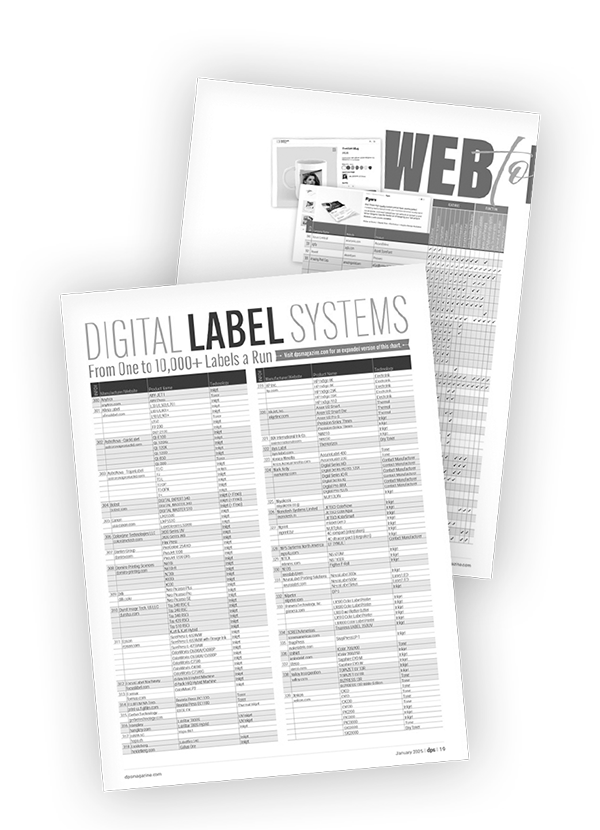
We asked the top 30 vendors and five honorable mentions to provide a company profile, as well as highlight up to three products that represent their ongoing commitment to the markets they serve. The products and associated INFO#s are presented in chart form for easy viewing starting on page 38. We encourage you to visit dpsmagdirect.com for more information.

Aleyant
Founded in 2005, Aleyant provides robust software services to the graphic communications industry at value-driven prices. Aleyant creates web to print (W2P), estimating and production, and prepress automation workflow software for graphic arts professionals. By unifying production processes, the company expands its customers’ ability to be more available, efficient, and profitable. Aleyant’s flagship W2P software, Pressero, is a customizable retail and business-to-business storefront interface and has launched many of its clients into the exciting world of internet-based print sales. Aleyant also offers a web-based online design and variable data publishing system, eDocBuilder, as a separate product, as well as Aleyant tFLOW, a powerful digital and large format automation workflow solution that is integrated into the Aleyant ecosystem. Aleyant PrintJobManager is a cloud-based print job manager solution that quickly generates estimates and market-driven pricing, provides job management, raw material inventory tracking, and planning across a variety of print production technologies and applications. It includes a Zapier account for connectivity to over 750 applications. Aleyant solutions are already integrated with multiple MIS and W2P systems and are easily integrated with other third-party offerings commonly used in printing operations.

Avanti
Avanti’s goal is to help its users deliver more jobs in less time with the confidence in knowing that every aspect of a shop is integrated into one powerful platform. The JDF-certified Avanti Slingshot solution allows for the sophistication required by today’s marketing service providers. The platform is able to manage multiple lines of business, handle large/grand format, digital and offset print, as well as mail and fulfillment workflows. Connect islands of automation, eliminate breakpoints in your workflow, and get the information you want—when you want it, and where you want it—easily, with Avanti Slingshot. From order entry through to production and billing, Avanti Slingshot enables you to work more efficiently, control your costs, and move more jobs through the shop with ease.

Canon
Canon U.S.A., Inc. is committed to helping its customers grow by providing an integrated array of automated, productive, user friendly, and profitable solutions. With one of the broadest portfolios in the industry the company develops hardware, such as digital presses and wide format printers, workflow software and professional services to assist a commercial printer in growing their business and profits. Canon U.S.A. is dedicated to its Kyosei philosophy of social and environmental responsibility.

Colordyne Technologies
Colordyne Technologies is a leading manufacturer of high-speed digital color print solutions powered by Memjet technologies. Colordyne specializes in affordable, high speed, high resolution industrial and production class label and tag color on demand inkjet printers—including sheets, roll-to-roll, and fan-fold—for a range of applications and industries at breakthrough speeds and cost effectiveness. Colordyne maintains two offices in Scottsdale, AZ and Brookfield, WI.

Duplo USA Corporation
For over 60 years, Duplo has set the standard with innovative and reliable finishing products in the graphic arts and continues to lead the way with solutions that are automated, productive, and cost efficient. Today, Duplo manufactures a complete line of print finishing equipment from all-in-one slitter/cutter/creasers, folders, and perfect binders to sheet feeding, bookletmaking, and saddle stitching systems for offset and digital printers in both high production and small office environments.

EFI
Headquartered in CA’s Silicon Valley, with offices worldwide, EFI is a leader in digital print. Offering value-added combinations of hardware, software, and consumables, the company is driving the print industry’s transformation from analog to digital color.

Epson America, Inc.
Epson America, Inc. offers an extensive array of award-winning image capture and image output products for business, commercial print, graphic arts, photographic, signage, direct to garment, and fabric production.

Fujifilm North America Corporation, Graphic Systems Division
The Graphic Systems Division of Fujifilm North America Corporation delivers solutions for workflow, consultative services, remote monitoring, color standardization and G7 implementation, pressroom products, CTP, proofing, digital printing, wide format, packaging, labels, and specialty printing. Fujifilm also manufactures and distributes Sericol inks and is a leader in the development of UV inks for screen printing, narrow web, and large format digital printing. Fujifilm is committed to minimizing the environmental impact of its products and operations, proactively working to preserve the environment, and strives to educate printers about environmental best practices.

GPA, Specialty Substrate Solutions
GPA redefines the boundaries of print by providing innovative substrates, personalized business solutions, and unparalleled support to the graphics arts. Founded in 1940, its product offering complements the widest range of printing technologies, including HP Indigo, dry toner, wide format, offset, and desktop printing to help make your impactful visions a reality. GPA is part of Fedrigoni Group, a leading international manufacturer and converter of specialty papers founded in 1888.

HP Inc.
HP Inc. creates technology that makes life better for everyone, everywhere. Through its portfolio of printers, PCs, mobile devices, solutions, and services, the company engineers experiences that amaze.

Kodak
Kodak is a technology company focused on imaging. The company provides—directly and through partnerships with other innovative companies—hardware, software, consumables, and services to customers in the graphic arts, commercial print, publishing, packaging, entertainment and commercial films, and consumer products markets. With its world-class R&D capabilities, innovative solutions portfolio, and highly trusted brand, Kodak is helping customers around the globe to sustainably grow their own businesses and enjoy their lives.

Konica Minolta Business
Solutions U.S.A., Inc.
Konica Minolta Business Solutions U.S.A., Inc. is reshaping and revolutionizing the Workplace of the Future. With its comprehensive portfolio, the company delivers solutions to leverage mobility, cloud services, and optimize business processes with workflow automation.

Magnum Magnetics
A U.S. manufacturer of flexible magnetic sheeting, strip, and custom profiles. The company offers printable magnetic sheeting for multiple printing presses including offset, flexographic, inkjet, and digital. Magnum Magnetics will take the time to understand your application before recommending a magnetic solution.

MBO America
Established in 1984, MBO America brought the renowned MBO brand to the U.S. Merging with Herzog + Heymann, manufacturer of specialized folding equipment, put MBO on the map as the most comprehensive, single-source provider of first class folding equipment and technology. MBO America is the only distributor that covers all bindery areas—folding, mailing, digital, die cutting—via its parent company’s solutions and partnerships with the most revered brands in postpress.

Melissa
Melissa is a leading provider of address management and list hygiene solutions. Choose from MAILERS+4 easy desktop mail preparation and presorting software, or Contact Zone to integrate, move, and cleanse data easily. Activate a free trial today. The company also offers NCOALink Move Update processing, phone, and email append. Looking for a mailing list? Create your own list and download in minutes consumer, business, email, and many specialty lists.

MGI USA
The MGI Group is a global digital printing technology leader composed of MGI Digital Technology, Kora-Packmat, and Ceradrop. MGI’s digital printing and finishing solutions apply to a range of industries, including commercial printers, plastic card manufacturers, government agencies, packaging and label converters, in plants, publishers, and photo printers. MGI digital printing solutions include the JETvarnish 3D product series and Meteor Unlimited Colors multi-substrate press lines.

Muller Martini Corp
Muller Martini is the world’s largest producer of print finishing solutions for commercial and book printers, trade binderies, and newspapers as well as short run and digital book manufacturers.

OKI Data Americas
OKI Data Americas continues to expand its presence in the digital production market with its C9 Series of five-color digital presses and ColorPainter wide format printers. Characterized by their ability to produce unique, advanced color output on an array of media, OKI’s industrial printers create new revenue streams for commercial printers, graphic designers, and signage industry entrepreneurs.

Pitney Bowes
Pitney Bowes is a global technology company powering billions of transactions—physical and digital—in the connected and borderless world of commerce. Clients around the world, including 90 percent of the Fortune 500, rely on products, solutions, services, and data from Pitney Bowes in the areas of customer information management, location intelligence, customer engagement, shipping, mailing, and global ecommerce. And with the innovative Pitney Bowes Commerce Cloud, clients can access the range of Pitney Bowes’ solutions, analytics, and APIs to drive commerce.

Ricoh USA, Inc.
Ricoh is a global technology company specializing in production print solutions, document management systems, office imaging equipment, visual communications systems, IT services, digital cameras, and industrial systems. Ricoh helps companies grow their businesses, improve customer engagement, and increase efficiencies by focusing on profitability, cost reduction, and document integrity. Ricoh’s Commercial & Industrial Printing Business Group leverages its advanced production print portfolio, proven software portfolio, and world-class professional services team to empower customers in the graphic arts community, in-plant shops, enterprises, and vertical industries to achieve these goals at an affordable price point and with customized solutions.

RISO, Inc.
RISO, Inc. is a supplier of cutsheet inkjet printers and accessories. The company’s compact, high-speed production printers provide fast, affordable full-color digital printing for everyday communications at speeds of up to 160 pages per minute. RISO’s digital duplicators include one- and two-color systems that reliably produce millions of copies, are environmentally friendly, and are easy and inexpensive to use.

Roland DGA Corporation
Roland DGA offers an extensive lineup of wide format inkjet printers and integrated printer/cutters, including TrueVIS, SOLJET, VersaEXPRESS, and VersaStudio eco-solvent printers, Texart dye-sublimation printers, and VersaUV UV printers. All Roland inkjet printers come bundled with powerful, easy-to-use RIP software, and several models offer specialty ink options, including White, Metallic Silver, Fluorescent, and Clear Coat inks.

Screen Americas
Long known as one of the graphic art’s dominant players in CTP and workflow, Screen is now a leading manufacturer of production class inkjet print engines helping its customers grow revenues, decrease costs, and find new business opportunities in diverse markets with inkjet printing technology for the high speed continuous, wide format, and label and packaging platforms.

Signs365
Signs365 is a pioneer of trade-only grand format printing.

SmartSoft, Inc.
SmartSoft provides industry-leading mailing, address quality, web to print, MIS, and workflow automation software. Products include the all-in-one print workflow management system PressWise, the AccuMail suite of postal address correction software, the all-in-one mailing solution, SmartAddresser 5, and the mail tracking service, MailSpotter.

Standard Finishing Systems
Standard distributes a comprehensive range of inline, offline, and near-line print finishing solutions, including perfect binders, folders, saddlestitchers, die cutters, bookletmakers, and collators from Horizon International of Japan, and unwinders, rewinders, cutters, stackers, perforators, and inspection systems for continuous feed from Hunkeler AG of Switzerland. Standard serves both the digital and inkjet print market and conventional offset print environment with effective, high-speed solutions designed to maximize efficiency and productivity.

Therm-O-Type Corp.
Manufacturer of the Zip line of digital finishing equipment, Therm-O-Type’s NSF series foil stamping/embossing/die cutting presses, foil fusing equipment and supplies, thermography, and business card slitting equipment.

Xeikon
Xeikon is an innovator in digital printing technology. The company designs, develops, and delivers web-fed digital color presses for labels and packaging applications, document printing, as well as commercial printing. These presses utilize LED-array-based dry toner electrophotography, open workflow software, and application-specific toners.

Xerox
Xerox Corporation is an $11 billion technology leader that innovates the way the world communicates, connects, and works. The company’s expertise is more important than ever as customers of all sizes look to improve productivity, maximize profitability, and increase satisfaction. It does this for small and mid-size businesses, large enterprises, governments, graphic communications providers, and for its partners who serve them. Xerox understands what’s at the heart of work—and all of the forms it can take. It embraces the increasingly complex world of paper and digital. Office and mobile. Personal and social. Every day across the globe—in more than 160 countries—its technology, software, and people successfully navigate those intersections. The company automates, personalizes, packages, analyzes, and secures information to keep its customers moving at an accelerated pace.

Zünd America, Inc.
Zünd, a leading manufacturer of digital flatbed cutting systems, offers multi-functional cutters/routers with a range of tools and automated/robotic material-handling options for processing rigid and flexible substrates. Designed for maximum versatility and modularity, G3/S3 and dual-beam D3 cutters are powered by Zünd Cut Center, a simple but comprehensive user interface and end-to-end production workflow for easy, productive, and profitable digital finishing.

Honorable Mentions
The Top 30 vendors represent only a small portion of the essential companies targeting digital print and document environments. Therefore, we couldn’t stop there! We also present five honorable mentions.

Durst Image Technology U.S.
Durst Image Technology U.S. is a manufacturer of professional wide and grand format digital UV inkjet printers, for today’s imaging industry. Durst products are designed for performance, reliability, and longevity, offering the highest print quality, productivity flexibility, and efficiency. Learn more about Durst product offerings and discover new business opportunities.

MBM Corporation
MBM Corporation provides cutting-edge finishing products for today’s digital printing industries. Its extensive product line includes world-class Triumph cutters, Aerocut digital print finishing systems, folders, creasers, collators, and bookletmakers. All MBM products are backed by a team of factory-trained technicians and one of the best warranty packages in the industry.

Rollem International
Rollem’s Insignia Series Die Cutters are designed to enhance products with die cutting, kiss-cutting, and embossing—ideal for packaging and promotional products up to 30 pt. thickness. Rollem’s Jetstream systems offer production-level slit/score/perforation functions on a variety of digital media. Rollem specializes in print finishing solutions for all sizes and types of print operations.

Sun Enterprises USA
Sun Enterprises USA manufactures business card slitters and the popular HS-100-Handi-Scor. The company features Gutter Cut for full-bleed cards—both automatic and manual—along with regular cut, ten- and 12-up formats. Skilled craftsmen build all machines in the U.S. Built to last, the products feature two-inch, high-carbon steel self-sharpening blades that are chain and gear driven—not belt driven.

Quadient (formerly GMC Software)
Quadient helps companies deliver meaningful interactions with current and future customers. A Neopost Digital Company, the Quadient portfolio of technology enables organizations to create better experiences for their customers through timely, optimized, contextual, highly individualized, and accurate communications for all channels. Quadient solutions bring together and activate the entire organization in the name of customer experience, through better collaboration and visibility into the customer journey. The company supports thousands of clients and partners worldwide in the financial services, insurance, and service provider industries in their quest to achieve customer experience excellence via mobile, digital, social media, and print technologies.

Editor’s Note
Congratulations to this year’s Top 30 Reader’s Choice and honorable mention winners. These companies help push the industry forward, promoting innovation and disruption among their competitors and clients.

We encourage readers to visit dpsmagdirect.com throughout the year to learn more about the companies and products covered in print and online.

Nov/Dec 2017, DPS Magazine

Pretty In Print

By Olivia Cahoon

Coatings enhance the appearance and durability of printed products, increasing the printed product’s value. Spot or flood coatings and varnishes in either UV or aqueous formulations are available. UV coating is popular for digital applications and recommended for paper products with full-coverage images like book covers, cards, and posters. Aqueous coatings offer fast drying capabilities and typically don’t require a heat lamp. These coatings are generally used to protect against blemishes, scratches, and smudges.

Here, we discuss considerations and challenges for coating digitally printed output in digital production environments, including method and the best equipment configuration.

Above: Steinemann continually develops its full flood and spot varnishing machines.

Enhancing Print
Coatings give digitally printed products added effects that range from matte to high gloss. Effects like high gloss help improve ink adhesion and overall print quality while matte and soft touch provides tactile appeal. This variety gives print providers the ability to meet an array of client demands.

Flood and spot coating capabilities ensure the market provides options for every digital need. Spot coating offers raised texture for physical touchpoints while flood coating covers the entire sheet to protect printed media and enhance colors.

Max Allen, dealer manager, Graphic Whizard, says advantages for coating digitally printed output include protecting toner on printed pieces, enhanced color, vibrancy, and water resistance.

To get the most from digitally coated pieces, Albert. J. Nuño, director of sales, Latin America, senior advisor coating solutions, Brandtjen & Kluge, Inc., says print providers should consider suppliers that handle a range of coatings like gloss, matte, and satin. “With digitally printed sheets you may have to have various suppliers for different applications,” he offers.

The range of coating options available bring benefits and challenges, which depend on coating type and method. According to Anthony Gandara, product manager, Duplo USA, raised UV spot coating is primarily used to highlight an image or text by applying varnish to a specified area. “Print providers can create and add their own embellishments to enhance the appeal and value of their products,” he says.

Challenges result from the chemistry between different types of coatings and inks. According to Gandara, compatibility between toners, oils, and paper helps avoid adhesion and coating issues.

Some digital inks are challenging for coatings to adhere to. Danielle Wood, marketing specialist, Harris & Bruno, says adhesion difficulty can be overcome by using a coater with various heat settings and working with coating suppliers.

She says Corona treatment is an alternative method for addressing adhesion issues. The process alters the surface energy of printed pieces with digital inks to allow adhesion. The treatment is used for plastic films and metallic foils and is applied before printing, laminating, or coating.

Industry Inclusive
Heavily handled applications are ideal candidates for coating treatments that add durability. Coatings provide protection with low-rub characteristics and are used for direct mail, folding carton, and packaging applications.

According to Nuño, digitally printed pieces handled in outdoor environments or those that come into contact with water are well served with a coating. “UV coating is the best product for these types of environments with scruff resistant, smooth layer, and solid adhesion properties,” he explains.

Allen believes any digitally printed piece handled regularly is well suited for coatings, especially business cards. He says a business card with a coating will stay in your pocket the way it was printed until you have a chance to hand it out.

Digitally printed direct mail benefits greatly from coating, which act to protect soft digital inks that scratch easily during handling. According to Wood, one quick pass through a digital coater puts a protective coating over any digital print to ensure it arrives in the customer’s hands looking as it did when mailed. “A coating creates the look and feel of offset printing and can be the finishing element that really catches the eye of the consumer on a printed piece,” she offers.

Other popular coated applications include beverages and containers, commercial printing, corrugated, flexible packaging, food service, and labels.

Coating Considerations
When looking to invest in a coater for digitally printed output, print providers must consider print applications, coating types, and the printers they use. Determine the proper coating solution based on application requirements like whether brighter colors or durability are more important. In addition, consider if the coating encounters food, which would require a non-toxic, food-safe solution. Once the print provider understands the end goal, it can determine compatible coatings.

For printing environments with multiple coating chemistries, Wood says it’s machines should support changeover to provide easy setup, washup, and minimal downtime. Additionally, automation, reliability, and high throughput are important—requiring the proper equipment and features for each coating type. “While a roll coater may handle simpler coatings well, a chamber/anilox system should be considered if a print provider is looking to use difficult-to-manage coatings with particulates,” she explains.

General considerations for coating equipment include sheet size, coating type, and run length. Roller coaters are suitable for high-quality finishes like high gloss UV, matte, soft touch, and pearlescent coatings. Some machines offer features for easily changing coatings, preventing smearing, and warming varnishes.

For UV spot varnishing, Ludwig W. Allgoewer, head of print enhancement, Steinemann Technology, says printers need an electronic registry for sheet-to-sheet correction at all times. He believes only coating machines with digital applied varnish offer this feature.

Additionally, prints from digital presses need a thin full-flood varnish before applying a UV spot varnish. “UV spot applications need an evenly closed surface to achieve good results with spot varnish, which makes proper full-flood pre-coating after printing a need in most cases,” explains Allgoewer.

Steady Solutions
As print, media, and priming solutions continue to advance, drivers for coating digitally printed output remain consistent. “We work in a competitive environment focused on creating value and increasing profit for printers,” says Wood. She believes technology’s advancing speed and the industry’s competitive nature keep high-quality coating in demand.

Allen agrees, adding that the drive for coatings hasn’t changed. This is a result of customers demanding professionally finished pieces for a low cost while printers seek ways to stand out and offer more to their customers—using digital coatings as a means for value-added effects.

According to Michael Barisonek, VP, sales and marketing, Epic Products International Corp., coating has always been a standard in offset, which in turn has affected digital. “Because of this, digital output protection will continue to be a requirement as printing and substrate advances address ink adhesion, not durability of the ink, after printing,” he says.

Nuño agrees and believes the demand for UV and aqueous coatings is growing. “With the on demand need that printers face, the protection and enhanced look coatings offer is still far better than what a digital press offers,” he adds.

Tactile Trends
Specialty trends like soft touch coatings gain popularity as clients demand quality features. According to Wood, these coatings provide the visual and tactile appeal that determines if a customer selects a package or mail marketing piece.

Soft touch coatings are a mix between matte and satin, giving the paper a velvet feeling that is fingerprint resistant. It can be applied inline during the printing process for fast drying or applied as an inline UV coating. It also protects against scruffs and smudges during finishing operations.

Soft touch coatings are an eco-friendly solution that is non-yellowing with an added gentle touch. It is used for book covers, business cards, brochures, catalogs, mailers, pamphlets, as well as postcards.

Nuño notices soft feel and soft touch coatings trending in the digital space. However, he warns that soft coating types can be challenging to apply with roller coaters.

Configuration Concerns
The choice between nearline/offline or inline coating solutions is determined based upon application, job length, and coating types. Each type has its own benefits and several devices available for either setup.

As a touch-free method, inline coating is beneficial for reducing labor by using a minimal number of employees to run the press in one pass. Inline coaters also reduce waste, a benefit that appeals to print providers of all sizes. Printed sheets are directly loaded into the feed tray—unlike offline coaters—and have features for two-way communication.

According to Wood, inline and nearline machines reduce the time to print and coat. She says offline machines should be considered when a printer has multiple print engines. “With this type of solution, the machine is available to be used for various applications and print devices, whether conventional or digital,” explains Wood. Offline solutions allow page priming and coating while maintenance is performed. However, if an inline machine’s workflow requires maintenance, the entire system is down.

Those with multiple print engines or longer runs typically choose nearline/offline solutions—especially with the use of multiple coating types. Offline solutions are accompanied with high-capacity stackers and feeders and chamber/anilox systems.

Using an automated UV coater, Allen says offline finishing has no limitation to the print engines being used. On the other hand, inline solutions mean only one engine can feed the machine.

Before selecting an inline or nearline/offline solution, Nuño suggests print providers consider how many presses require the sheets to be coated. “If you go inline, then you are limiting the use of that coater to that press—forcing your shop to get more coaters to accommodate other presses. However, inline increases productivity for any one press,” he explains.

The price differences between inline and nearline/offline solutions is generally application dependent. To get the best comparison between the two types of equipment, print providers should consider features and service costs that may be added or required to operate digital coaters. “Generally, a solution with a separate feeding system will be more expensive than adding a conveyor to connect another machine,” explains Allen.

Gandara warns there is almost always a service cost required for inline operation, however, finance options may be more easily acquired.

Andy Brannon, national sales director, American Ultraviolet Coating (AUV), points out that inline coater solutions have a large footprint and price tag. “The large print providers with major output have put considerable capital into inline coating solutions,” he explains.

However, Wood believes inline typically costs less because nearline/offline digital coaters require additional features to purchase. Optional features can be used to automate priming, stacking, and feeding.

According to Nuño, the price difference between nearline/offline digital coaters to inline isn’t very different. He believes savings is only apparent when print providers go offline without a feeder and feed by hand. “Many shops start off this way. Handfeeding can yield up to 2,000 sheets per hour (sph),” he shares.

Coating Solutions
Here are product highlights from coaters serving digital print environments.

Alliance Technology Corporation (ATC)’s UV-36SD Cyclone is an offline, sheet-fed liquid coating system for protecting and enhancing output materials from digital and photo printers, featuring a coating width of 36 inches and thickness up to one inch. ATC also offers its UV13 Cyclone offline with a coating width of 13 inches and thickness up to .75 inches.

AUV digital coating systems handle a maximum width of 52 inches or any length when fed by hand. The AUV systems handle roller coater and peristaltic pump compatible coatings. “We have provided our systems to all sizes of print providers, even some that have an inline solution per their production needs,” shares Brannon.

AUV engineers and manufactures nearline/offline UV and aqueous roll coater systems. The systems can be palletized with AUV universal feeder and stacker lines.

The company also offers the Linear Measurement System (LMS) for print providers that need coating on digital output and non-paper substrates. The LMS determines exact digital calibration to change between thin and thicker substrates including non-paper substrates.

Brandtjen & Kluge offers inline and nearline/offline equipment. “Customers choose how they want their setup and we make the recommendation based on their needs,” says Nuño. Its coaters are made for a variety of applications including cardboard, paper, plastic, and wood.

Released in July 2017, the Brandtjen & Kluge OmniCoat 1800S and 3000S Servo are compatible with gloss, matte, primer, satin, and soft touch coatings. The coaters feature a user-friendly touchscreen panel and precision self-roller adjusting. It is equipped with an AutoFeeder and Stacker and runs 5,000 sph.

Nuño says the coating devices are memory capable and feature lower power consumption as well as fast and easy cleanup. OmniCoat has less than a five minute startup and five minute cleanup with gloss coating. Matte, satin, and aqueous coatings entail 15 to 30 minute cleanups. The 1800S is $40,000 and the 3000S is $50,000.

Duplo offers offline solutions for UV flood and spot coating. Released earlier this year, the DDC-810 Raised UV Spot Coater includes 600×600 dpi inkjet heads and handles a maximum paper size of 14×29 inches. It features adjustable varnish thickness from 20 to 80 microns in addition to an air suction feed system with almost six-inch feed capacity. The coater processes up to 36 pages per minute (ppm) in letter size and 21 ppm in ledger.

Job preparation is easy with the PC Controller, which is included with the DDC-810, says Gandara. “Using the PC Controller software on the DDC-810, operators can set up a job in four steps and begin production in minutes,” he explains.

The DDC-810 is compatible with coating types from HP, Xerox, and offset solutions. While still under development, Gandara says laminated media from Canon, Konica Minolta, and Ricoh are also compatible.

The coater’s CCD camera system automatically corrects for shrinkage, stretch, and skew. Unique registration marks allow precise alignment of the spot UV layer onto the printed document. The DDC-810 coater is $160,000 with a preventative maintenance agreement.

EMT International offers the Chameleon Coater, which is available in its UVF20, UVF30, and UVF42 models for 20-, 30-, and 42-inch web width applications, respectively. The device operates in simplex or duplex capability with a standard speed of up to 500 feet per minute (fpm)—higher speed options are available. It features inline or near-line UV coating with an aqueous coating option available.

Epic Products offers inline and nearline solutions and configures coating systems according to customers’ needs and requirements. Its newest coating system—the Epic CT-750—is an integrated sheetfed coater for B2 formats.

The Epic CT-750 applies spot coating in UV, aqueous, or specialty coatings like blister or soft touch. It feeds 29.5-inch sheet sizes and offers glue tab and knock out capabilities. According to Barisonek, it can run inline with presses of this size or offline with a feeder.

Epic also offers the Web Coating System for duplex coating with inkjet and digital webs. UV and aqueous coatings are supported with 20-, 30-, and 40-inch widths up to 1,000 fpm. “Epic Products has a list of suggested UV and aqueous formulations tested with various stocks and printing methods, and we offer testing services to customers and printers considering Epic coating systems,” shares Barisonek.

GMP offers its SureCoater Series for print on demand environments. Ideal for a range of applications it features an ergonomic touchscreen for easier operator control. The series offers adjustable UV intensity, precise coating thickness adjustment, and a compact design, gloss and matte coating, and an automatic UV recirculation pumping system.

Graphic Whizard’s UV coaters are offline systems and can be run inline with finishing equipment to automate and remove touch points. According to Allen, Graphic Whizard partners with Actega and Kelstar for coating and recommends them to customers. “The samples we run in house are all from Actega,” he adds.

Actega offers water- and UV-based overprint varnishes and coatings including rigid metal coatings for food cans and protective coatings for flexible packaging.

Graphic Whizard’s VividCoater XDC 370M is a digital coating system that handles multiple coating types. It is a 14.5-inch wide, full-flood machine with touchscreen controls, removable roller, and three IR lamps with adjustable intensity.

The coater can be used as an inline installation to any digital print engine or inline Graphic Whizard creasing and feeding device. The XDC 370M features a three-pump coating system.

Harris & Bruno offers inline and nearline/offline coating solutions for a variety of machines and applications. “We provide solutions for both large commercial print environments and smaller print environments, and as a result, our machines may see many different applications,” says Wood.

Released in September 2017, the ExcelCoat ZRS30 Spot Coater is compatible with all types of UV and aqueous coatings including glitter, gloss, high gloss, matte, pearlescent, soft touch, and specialty coatings. It handles inline and offline spot or flood coating and has a 29.5-inch coating width. The ZRS30 utilizes a camera registration system to compensate for digital drift.

“High throughput and increased efficiency make it ideal for packaging and commercial print applications,” offers Wood. The ZRS30 is priced between $50,000 and over $300,000 depending on features and applications.

Kompac provides a variety of coating solutions, including its ELITE line for labels, EZ Koat for flood coating, and Kwik Finish products for spot coating.

MGI offers its JETvarnish 3D products for spot coating effects. The company’s JETvarnish 3D Evolution is a B1+ format device specially designed to offer digital and offset printers a scalable upgrade path for a full range of production environments and postpress applications.

Print enhancement machine provider, Scodix, offers the Scodix Ultra Digital Press and the Scodix Ultra Pro, which enable specialty coating. Additionally, the company’s S-Series allows print providers to add tangible dimensions that stand out.

Shark Machinery presents several coating solutions, including its latest SUV-24 PLUS UV Coater, which offers a “glass like” finish, according to the company. Similar to its other coaters, the machine coats using traditional UV coating liquid, but also has the ability to offer a soft touch and glass shine effect. The machine offers a maximum width of 25.25 inches and is compatible with both offset and digitally printed stocks.

Steinemann Colibri systems are used for full flood coating of digitally printed products in commercial applications. The Colibiri line may be operated for UV varnish, aqueous, or hybrid coatings and suits a variety of applications including matte and soft-touch varnishes.

Colibri systems handle 12,000 sph and are compatible with a range of substrates including adhesive labels, cardboard, magnetic, paper, and plastic. Smith says the systems can be alternatively equipped with a roller coater for full flood varnishing or an Anilox roller.

The company also features its dmax digital inkjet systems for spot and relief varnishing. Featuring performance of up to 10,000 sph, the machine offers minimal setup times and high substrate flexibility.

TEC Lighting’s TruCoat UV Coater features an easy-to-use touchscreen, variable intensity IR lamps, and quick-change rollers that take only five minutes to replace, according to the company.

Targeting digitally printed folding cartons, TRESU DigitalSolutions provides coating technology for an efficient, single-pass digital folding carton workflow. TRESU’s modular coating systems apply full-surface, spot, and line varnishes inline with the latest digital printing presses from leading OEMs. They work with a range of UV-curable and water-based coating media, to create gloss, matte, soft touch, and metallic effects. These are specially formulated by TRESU to perform in the unique conditions of the digital line.

Coating Necessary
A range of features and capabilities differentiate digital coaters from one another in addition to compatible coating types and configurations. Print providers offer coating for digitally printed output to add vibrancy and durability to a range of applications from business cards and book covers to labels and packaging. With demands for stronger durability and special effects, the coating landscape continues to expand for on demand and high-volume production environments.

Nov/Dec 2017, DPS Magazine

You’ve Got Direct Mail

By Olivia Cahoon

Digital marketing service providers depend on finishing equipment including folders, inserting equipment, and mailing systems. Finishing for direct mail includes required functions like cutting, document printing, and folding. However, optional features like coatings and UV varnishes gain a reputation for eye-catching details.

“Personalization and high-quality finishes are a great way to attract attention,” comments Grant Miller, president, Pitney Bowes Document Messaging Technologies.

It’s also important for print providers to consider tools that support high-volume direct mail providers for overall efficiency, productivity, and postage discounts to optimize the value of each mail piece.

Above: VITS International’s VITS Express digital finishing line.

Direct Mail Must Haves
Specific requirements for direct mail include data management, as well as finishing functions like cutting, document printing, insering, and folding.

Data cleansing is a critical component for all direct mail campaigns. Brian Euclide, president, TEC Mailing Solutions, believes that all the best designs and manufacturing in the world will do nothing for a poorly or incorrectly addressed mail piece. Basic functions for standardization and change of address are integral for correct mailing information.

According to Miller, companies also use personalization to improve alignment across digital and print communications by targeting each recipient with messaging specific to their needs.

Nick Gerovac, director of sales and marketing, VITS International, agrees and says the inclusion of customer-specific information, personalization, and personalized offers is effective to increase response rates when compared to a shot-gun approach of sending the same piece of mail to all the recipients with the hopes of triggering a response.

Aside from personalization, Greg Padowitz, director, technical sales support, BOWE SYSTEC North America Inc., says inserting platforms must have extremely flexible enclosure material handling capabilities and a wide tolerance of material variations. “The method of insertion must also be gentle on the material to prevent marring the finish of the inserts,” he notes.

Additionally, functions in the manufacturing process, like sortation software, improve automation compatibility for lowering postage costs. Euclide believes lowering the overall postage is dependent upon the manufacturer’s use of a third party to provide greater saturation discounts. Without a third-party function, he says the manufacturer must maintain and utilize quality sortation software to create the best possible groupings of saturation for the mail—achieving the lowest possible postage rates.

Optional functions allow print providers to offer value-added features that drive more attention towards the direct mail piece. These include effects like full-color envelope printing, perforated die cutting, personalization, scratch offs, and loyalty cards.

Andrew Schipke, VP of sales and marketing, W+D North America Inc., says he has seen an increase in the demand for photopolymer embossing technology, which is an alternative to engraved steel embossing cylinders.

However, Miller believes that while optional functions do drive more attention and help messages pop on paper, the additional cost of these technologies tends to make it less essential.

Many of the optional functions for direct mail finishing equipment are also found in the tools high-volume direct mail providers use.

High Vs. Low Volume
Companies with high volumes of direct mail equip their lineups with machines that reflect the quantity of mail output. To ensure the communication streams run smoothly, high-volume direct mail providers use numerous tools.

This includes tools to automatically change the envelope and material formats without extended periods of mechanical fine tuning. In addition, Padowitz believes production-level tracking anticipates disruption for efficient scheduling and meeting service-level agreement requirements.

High-volume environments also benefit from extended feeding capabilities, full-color printing on envelopes, heavier inserts, and tracking capabilities.

High-volume equipment requires a more robust design and is meant to be run at higher speeds. “The mail room solutions from years ago are okay for lower volume environments, but when you increase your production requirement you need reliable equipment that can run uninterrupted,” says Gerovac.

According to Miller this can begin with digital elements like file composition and creation to the data quality aspect of direct mail. He explains that production equipment’s capabilities are often tailor made from both a size and scale prospective.

Steve Jarvis, sales manager, KAS Paper Systems Ltd., stresses the importance of achieving quick setup and quick changeover from one mailing job to the next. He suggests the use of insert feeders that are not dedicated to run one type of document, like booklets or folded documents, which have a certain type of fold.

Because of the lower volume and demand, Gerovac says that lower-end segments can work with older, less sophisticated and less robust equipment to complete direct mail jobs. These environments tend to rely on larger labor forces and manual processes.

Euclide argues that the introduction of cloud-based address/data cleansing and sortation tools has leveled the playing field. “Today, virtually any level of provider can achieve the same exact level of address quality and USPS sortation levels as the largest of the mailers,” he shares. By engaging cloud-based technology with digital press equipment, direct mail tools can be achieved without purchasing large amounts of hardware or software—eliminating software maintenance.

USPS Incentives
Digital print providers that offer direct mail must be aware of the latest USPS discounts and regulations to save costs and eliminate bottlenecks. USPS discount structures tend to be offered for limited times, a difficult task for direct mail marketers to individually adjust to and take full advantage of.

“USPS is becoming more competitive by changing their rate structures around packages and parcels and negotiating service agreements,” says Miller. He suggests marketers work with a vendor knowledgeable of the market to consolidate mail through the workflow system and stay up to date on the changes in regulation and pricing. “Direct mail equipment needs to be adaptable to the changing price of structures to ensure that marketers are optimizing the value of each mail piece and reaping the benefits of cost savings on postage wherever possible,” he adds.

Padowitz agrees and says that discounts that center around TransPromo, tactile, and full-color features require direct mailers to update technology in order to stay competitive in the marketplace.

Progressive Mail
Direct mail is a successful marketing tool that is becoming more targeted to the individual with higher quality. “Personal shopping history, the car you drive, or the music you listen to—it’s all being captured so that marketers know what products to place in front of you,” says Gerovac. The more specific direct mail becomes, the higher the return on investment is for marketers.

As a result of higher quality print, Miller believes marketers are now more inclined to print on glossier stocks and embrace embossment for unique finishing—all to grab the attention of the audience. Other expanding technologies include specific cutting technology to create uniquely cut and folded pieces.

Bill Papp, product manager, Document Data Solutions, LLC. (DDS), notices clients of direct mail houses demanding increased integrity and proof of mailing. He believes HIPPA requirements and tougher postal regulations are contributing to this trend. To solve this problem, vision integrity systems help ensure all items within a mail piece are correct and that each piece of mail is processed.

Papp adds that read-and-print systems are also used to print variable information like the recipient’s name and address, specific marketing information, and full color on a closed face envelope with total percent accuracy.

Schipke sees increased interest in NFC tags since Apple opened its iPhone to the technology. NFC tags store large amounts of information like text, web addresses, and contact details that link to applications. NFC tags are a flexible alternative to barcodes and quick response (QR) codes because the information can be edited at any time without creating a new NFC tag. “They eliminate a secondary and labor intensive slow manual inserting process,” he says.

Multichannel information impacts the engagement of direct mail. Euclide believes the combination of physical mail, USPS tracking data, and email have created a closed-loop system to actively engage the consumer before, during, and after the mail piece is received—driving greater attention to the piece and the offer.

The direct mailers also seek reduced workflow, simpler machinery to operate, and reduced costs to produce finished envelopes that offer new sensory features. Schipke says high-valued features include shape cutting, patch foiling, UV coating, QR codes, digital watermarking, and inkjet printing for personalization.

Direct Mail Equipment
A range of finishing equipment is available for direct mail applications.

BOWE SYSTEC North America Inc. offers Fusion Cross, a single machine type strategy that allows high-speed processing of #7 envelopes to jumbo flat sized envelopes. Padowitz says it provides a fully automatic changeover and flexibility for enclosure material types and thicknesses. Fusion Cross is intended for medium- to high-volume users with up to 22,000 folded formats per hour to 16,000 flats per hour.

DDS offers the iDataManager, iDataScan, and iDataRepair. “DDS provides vision integrity systems capable of ensuring that all items within a given mail piece are correct and each piece of mail in a mailing has been processed,” says Papp. iDataManager is an enterprise-wide software solution with built-in tools that manage information across multiple systems.

KAS Paper Systems Ltd. features the KAS Mailmaster Eclipse. It performs feeding, folding, and barcode reading of multiple page prime documents and letters. It includes an over-track feeder for feeding smaller items. The Mailmaster Eclipse inserts C4/C5/DL envelopes up to 8,000 packs per hour with data logging on all documents and envelopes.

The Kirk-Rudy KR545T tabbing system applies tabs to three sides of a mail piece at the same time. “This patented machine was invented by our team of engineers to meet the change in USPS tabbing regulations a few years ago that required all sides of a folded booklet be closed with a tab or wafer seal,” says Jim Williams, director of marketing, Kirk-Rudy. The KR545T handles 18-inch diameter rolls.

Pitney Bowes offers the FlowMaster RS inserting system. It delivers letters up to 16,000 per hour and flats up to 12,000 per hour. The FlowMaster RS is intended for production sizes between one and two million per month. The solution provides mailers with the ability to expand services and reduce labor.

Rollem International’s Mailstream combines multiple processes in one system to reduce labor costs. It handles digital or offset sheets and converts press sheets to finished direct mail in one process. The sheets are edge trimmed, slit, scored, and perforated in both directions. Susan Corwin, marketing manager, Rollem International, says T and L perfs are applied for reply cards, coupons, cart tip-on, re-moist glue, folding and three dot glue closure—with all processes completed in one pass.

VITS International offers the VITS Express digital finishing line, which includes functions like folding, perforating, die cut, letter insert, glue, fold, and cut. It includes the VITS Express Rotary Cutter, designed for dynamic cut length and chip size. Gerovac says it is inkjet web compatible from 20- to 42-inch wide webs at 1,000 feet per minute.

W+D North America markets the W+D Halm iJET envelope over print press and W+D 410 Easy Enveloper to direct mail finishing. The Halm iJET produces 32,000 #10 envelopers per hour. The 410 Easy Enveloper converts short-run offset or digitally printed rectangular sheets into finished direct mail envelopes. Depending on configuration, it produces up to 30,000 finished #10 envelopes with a window per hour.

Software
Software is increasingly important as mailings become more complex. Many software solutions target direct mail environments and offer functions for better data quality and deliverability for mailings.

“You printed it, why not mail it too?” asks Corry Casler, director of sales, PressWise by SmartSoft. “With the right software you can simply integrate mailing services right into your existing digital print workflow, capture additional revenue, and make it more convenient and cost effective for your customers to do business with you.”

Melissa’s software solutions address data quality. The company’s MAILERS+4 Postal Automation Software targets professional mailers that need data verification, postal presorts, and postal reporting capabilities. It saves users money through postal discounts, brings ZIP+4 accuracy to databases with Delivery Point Validation, and lowers undeliverable mail. For lower volume mailers, Melissa offers a Standard Version of MAILERS+4.

Quadient’s Bulk Mailer helps users ensure mail deliverability, navigate complex postal regulations, and achieve the lowest postage rates. Productivity features include wizard-based processes, reusable task templates, comprehensive data exchange, and a mailpiece designer.

Smartsoft—the developers of the PressWise workflow platform—offer the SmartAddresser 5. The all-in-one mailing software solution provides a range of features from CASS Certified address verification and advanced deduplication technology, to PAVE Certified Presorting and Job Scripting capabilities. Innovations such as the Print Layout Assistant are designed to ease envelope and label design, and its reporting tool generates postal reports as well as provides the ability to create own custom reports.

TEC Mailing Solutions’ MailPreparer.com is a web-based alternative to desktop mailing software. It is a USPS certified cloud-based solution for address data cleansing and presort that includes functionality for every-door direct mail and all mail classes while providing data appending, geo-coding, and USPS tracking services.

Direct Mail Ready
Direct mail embraces the possibility of digital print with optional finishing functions like full-color envelope printing, foiling, as well as personalization. High-volume direct mail providers must equip themselves with productive and efficient finishing equipment for longer run lengths and smooth communication streams.

Nov/Dec 2017, DPS Magazine

Print 17 Takes Over Chicago

By DPS Staff

Print professionals visited Chicago, IL’s McCormick Place from September 10 to 14, 2017 for the Print event’s return to the venue. The event is a comprehensive exhibition for printing and imaging professionals. It featured live equipment demonstrations as well as educational sessions and panels.

Attendees to Print 17 were invited to design their own “Learning Experience” at the show. They could do so through sitting in on more than the 50 education sessions that shed light on topics ranging from design/creative process, packaging, marketing, growth strategies, and emerging technologies.

Above: Print professionals visited Chicago, IL’s McCormick Place from September 10 to 14, 2017 for the Print event’s return to the venue.

Exhibitor Focus
The main focus of the event was the 450-plus exhibitors showcasing the latest hardware, software, substrates, and services.

Digital technologies dominated the show floor, featuring equipment including both toner- and inkjet-based offerings.

Canon used the event to unveil its Océ VarioPrint 6000 TITAN Series of sheetfed monochrome production presses. It is planned for 2018 availability. The company also showcased a life-sized prototype of its Voyager B2+ duplex Voyager Inkjet Photo Press and samples from the Canon Océ ProStream inkjet printer, which targets commercial applications with high-quality output.

Fujifilm North America Corporation featured live demonstrations of the JPress 720S sheetfed inkjet press, which showcased how quickly variable data driven, short-run projects are staged and run.

HP Inc. announced enhancements to the HP Indigo 12000 Digital Press, which now includes new High Definition Laser Array technology, enabling the press to double image resolution up to 1,625 dpi, according to the company.

Komori highlighted its 29-inch inkjet sheetfed UV printing system, the Impremia IS29. The device runs a 23×29-inch sheet, ideal for six-up print production.

Konica Minolta demonstrated a variety of its commercial industrial technologies. It also showcased solutions from its strategic partner, MGI. Products displayed included the Konica Minolta bizhub PRESS C71cf label printer as well as the MGI JETvarnish 3D Web varnish and foil solution. It previewed the MGI CeraPrinter X-Serie Printer and offered a virtual reality experience of the AccurioJet KM-1.

Memjet introduced its new DuraLink digital printing platform, which combines long-life printheads, pigment ink, and flexible modules to provide its OEM partners with a fast and easy way to develop solutions for high-volume commercial, packaging, and industrial printing markets.

Ricoh USA, Inc. highlighted both new and proven solutions for current and perspective customers. The recently formed Commercial & Industrial Printing Business Group took center stage. Several solutions were on the floor, including the Ricoh Pro C7100X five-color digital press, the flagship Ricoh Pro C9100, and the Rioch Pro 8200 high-speed, flexible B&W digital press. Displayed for the first time in the U.S. was the Ricoh Pro VC400 continuous feed inkjet platform.

Screen Americas highlighted recent developments of its TruePress Jet L350UV+LM, a new UV inkjet system designed to expand the ability to print labels for food packages.

Xanté introduced the UV4000 UV-curable flatbed printer, which features printheads that rise up 11 inches, enabling it to print on specialty media and rigid substrates.

Xerox featured the Xerox Trivor 2400 High Fusion Inkjet Press and the Xerox iGen 5 Press, which includes the newly introduced White Ink for its fifth printing station.

Finishing equipment targeting digital print environments was prevalent on the floor as well.

BDT joined forces with Canon, introducing the VX-370-Long Sheet Feeder, an integrated solution that enables users of the Canon imagePRESS C10000VP to produce banner format applications at high volumes.

Duplo highlighted the new DDC-810 Raised Spot UV Coater, a compact design-driven solution that utilizes 600×600 dpi inkjet technology. It features an air suction feed system and handles maximum paper sizes of 14.33×29.13 inches and up to 450 gsm.

Graphic Whizard featured a range of on demand printing equipment, including the new PT331 SSC Slitter/Cutter/Creaser.

Martin Yale revealed its refreshed brand at Print 17, which is designed to better reflect and build on the company’s legacy and core values. It also announced its newest product, the KF-250 Stand-Alone Knife Folder.

Muller Martini featured Finishing 4.0, offering daily demonstrations that showcased the future of finishing. Center to this is the Connext Workflow System, the company’s singular software solution that oversees, directs, troubleshoots, and validates the quality and integrity of the entire printing process.

Standard Finishing Solutions offered live demonstrations of many finishing technologies, including die cutting, perfect binding, and trimming, slitting and creasing, folding, saddlestitching, inspection systems, and roll-fed print solutions. New products displayed included the Horizon BQ-480 Perfect Binder and two saddlestitchers made their North American debuts at the show. Also premiering in North America was the Hunkeler POPP8 finishing line for roll-to-stack production, which builds off of the success of the company’s POPP6 line.

Software and workflow providers shared solutions for better marketing, more efficient print, and improved color management throughout the show floor.

Crawford Technologies announced several products, including the availability of TurboFlow, a solution that allows changes to be made to individual document pages during post composition. It also announced the general release of Review and Release, a solution that automates and simplifies the process of removing specific files from a print stream before printing, and the introduction of PRO Lockdown, a technology solution designed to add an additional layer of security to print files.

EFI’s Fiery FS300 Pro technology made its worldwide debut as the next-generation platform for Fiery digital front ends used with sheetfed, high-speed continuous feed inkjet, B1 folding carton, and corrugated digital presses.

GMC Software announced it is now part of a newly integrated company, which operates under the name Quadient. Quadient integrates the omnichannel customer communications management, data quality, and postal capabilities of three Neopost sister companies—GMC Software, Human Inference, and Satori Software.

Graph Expo 2018
For a more detailed account of exhibitors and products introduced and highlighted at Print 17, head over to dpsmagazine.com.

Next year, Graph Expo returns to Chicago, IL from September 30 to October 3, 2018 at McCormick Place.

Nov/Dec 2017, DPS Magazine

thINK 2017

By Olivia Cahoon

thINK is a self-governed and growing community of more than 400 members in relation to Canon Solutions America’s production print customers. The community provides a forum for members to network, gain knowledge, discuss common challenges, and share best practices for production inkjet printing.

For the third consecutive year, the organization held its user conference to focus on innovation, customer experience, and world-class education. Production inkjet customers, solution partners, and print industry experts totaling over 570 attendees gathered in Boca Raton, FL from October 9 to 11, 2017 at the Boca Raton Resort & Club, a Waldorf Astoria Resort.

Supported by Canon Solutions America, thINK builds upon available resources to provide members with inkjet tools, videos, market research, and white papers to meet the evolving needs of the growing inkjet community.

Above: For the third consecutive year, Canon Solutions America’s production inkjet customers, solution partners, and print industry experts gathered in Boca Raton, FL for the thINK Conference.

Collaborative & Connected
The third thINK conference took off with a welcome note from Victor Bohnert, executive director, thINK; Francis A. McMahon, SVP, marketing and sales operations, Canon Solutions America; Mark DeBoer, president, thINK; Eric Hawkinson, senior director, marketing, Canon Solutions America, and Christian Unterberger, chief marketing office/EVP, Océ—A Canon Company.

During the welcome note, Unterberger discussed the Canon Voyager, which is scheduled for release in 2018. The Voyager features print speeds of 3,000 sheets per hour (sph) in 30×22-inch simplex mode and 18,000 sph letter sizes six and up. It’s designed to be paper agnostic—referring to versatile media compatibility. Designed for the high-end commercial and photo application markets, it features duplex printing and seven colors.

During the welcome note, Mal Baboyian, EVP, large format solutions/production print solutions, Canon Solutions America, who is retiring after over 40 years in the industry, was recognized for his contribution to the company.

Spanning three days, the conference featured three keynote speakers, including Captain Mark Kelly, commander of the space shuttle Endeavour’s final mission, space and aviation contributor, NBC News/MSNBC; Greg McKeown, CEO, THIS Inc., and James “Jim” P. Cochrane, CCMO, USPS.

Kelly concluded the welcoming note by sharing his life experiences and demonstrating how focus, dedication, and persistence can help attendees find potential to succeed in any competitive setting. He discussed life lessons from his experiences in the navy, outer space, as well as the recovery and resilience of his wife, Gabrielle Giffords, a former AZ congresswoman.

thINK provided attendees with Klik bracelets for networking. Sponsored by International Paper, thINK attendees bumped Klik bracelets with one another to instantly exchange contact information and earn points for prizes. Points were given for connecting, attending sessions, and visiting partner booths.

Additionally, the event featured a Partner Pavilion, hosting booths from thINK sponsors including Appleton Coated, Appvion, Arcis Solutions, BCC Software, C.P. Bourg, Crawford Technologies, Crown Van Gelder, Dalim Software, Domtar, Double A, Duplo, EMT International, Epic Products International, Glatfelter, Georgia Pacific, Harris & Bruno, International Paper, Ironsides Technology, Lindenmeyr Munroe, MBO America, Messagepoint, Midland Paper, MindFire, Mitsubishi Imaging (MBM), Inc., mondi, Muller Martini, OneVision, Quadient, Racami, Rochester Software Associates, Sefas, Solimar Systems, Standard, Tecnau, Trekk, Ultimate TechnoGraphics, Verso, and Videk.

The event offered 25 educational sessions designed for all levels of inkjet experience. Over 50 speakers presented on topics including color profiling, continuous feed inkjet, customer management, finishing, G7 calibration, high-speed inkjet, inkjet workflows, marketing, production efficiencies, and sheet-fed inkjet.

During Cochrane’s closing keynote, Attention at the Convergence of Physical and Digital, he introduced the USPS’ newest consumer-facing feature, Informed Delivery. Informed Delivery provides users with digital previews of their household mail arriving soon including mail piece, representative images, and supplemental content like URLs.

At this time Cochrane also discussed the direct mail market, revealing a 150 percent increase in direct mail sales by adding texture and that 86 percent of consumers admit personalization plays a role in decision making.

McKeown concluded the closing note by discussing his bestselling book, Essentialism: The Disciplined Pursuit of Less. McKeown suggested attendees consider how spending 80 percent of time on the vital few rather than the trivial can affect business as well as personal goals. His clients include Airbnb, Apple, Google, Facebook, and Pixar.

The conference wrapped up with Canon Customer Experience Center tours, which featured demonstrations of the Océ ProStream 1000. The Océ ProStream 1000 features a maximum print speed of 262 square feet per hour at 22 inches wide. It uses Canon ColorGrip technology and pigment based polymer ink with a high-capacity duty cycle up to 35 million A4 pages per month. ColorGrip enhances image quality on papers not designed for inkjet.

thINK 2017
The third annual thINK conference experienced a 25 percent increase in overall attendance compared to thINK 2016. As production inkjet technologies continue to advance, thINK helps its members feel a sense of community and succeed through education and networking.

Nov/Dec 2017, DPS Magazine