Printing the Everyday

By Cassandra Balentine

Chatbooks leverages the power of social media and the latest digital print technology to ensure social photos make it to printed form. A smartphone application (app) connects to users’ social media accounts and photo libraries to quickly and easily layout a photobook. The designed photobook is seamlessly sent to a professional print provider right from the app. The process can be done entirely on the user’s smartphone automatically in minutes, and physical, digitally printed books are mailed to the user for a nominal fee within a couple of weeks.

The primary product is a 6×6 inch, 60-page photobook that features the images, date, and location of photos shared to the social media site of choice—most popularly, Instagram. While many of its users are signed up for a subscription service that automatically creates a book once the user has the appropriate amount of shared images. It also offers custom books, which are created by the user on demand.

Application-Based Printing
Based out of Provo, UT, Chatbooks printed its first book in 2014. The concept of the app stemmed from a social media website idea by the founders that pivoted direction after they realized the need for consumers to get photos out of the cloud and into physically printed books.

Chatbooks started utilizing an API with the popular mobile app, Instagram. Today the company says this is still its primary outlet, but it has expanded to integrate with Facebook as well as directly to smartphones. Once a user signs up and connects their account, the app automatically creates a book, enabling users to easily accept photos, or take a few minutes to edit and perfect it.

Dan Jimenez, COO/CFO, Chatbooks, says the company was founded based on the realization that people were documenting their lives online. Consumers are taking more photos than ever before, but they stopped printing them because it became difficult and expensive. He suggests that most people have created about one and a half photobooks in their lifetime, which is a frustrating and costly process. “We felt that there is no reason why it can’t be easier. There are endless possibilities to make creating a photobook both super easy and affordable.”

This product would not be possible without the flexibility of digital print. The books are sized to 6×6 inches. The size is ideal because it plays into the affordability and quality of the books. The size was chosen based on the presses’ sheet size to maximize printing efficiency.

It also happens that the book’s standard size fits a four-inch photo with room to include the location, date, and caption within the layout. Since one downfall of social media is the size restriction on posted photos, the four-inch size works well with the quality level of a photo coming off of one of these sites.

Efficient Print
To keep the costs of the books low—a typical Chatbook is $8 including free standard shipping—print costs must also be kept to a minimum.

Chatbooks handles the software prior to print, but actual production is done through partner printers that utilize HP Indigo equipment.

As the company continues to grow, so does its printer network. At the beginning, a local print provider handled the printing for Chatbooks. “When the company started, one of the founders had a good friend running a print shop down the road. They worked together to develop the final product. We worked with them for the first two years and realized we needed more capacity,” says Jimenez.

The company filled orders for 500,000 books in the first year, but in 18 months it was one million. At over two years old, they have sold over two million books. “Pace is picking up so we’ve had to improve our supply chain along the way,” he shares.

Today they have a network of three printer providers.

Chatbooks continuously sends orders to its print partners. They generate print-ready PDFs that are passed over to an API with a logic that decides what files are sent to which printer. Once the files are sent, the print providers download them and process the books however is most efficient for them. Typically the orders are batch processed.

Jimenez estimates that Chatbooks generally send out several thousand books per day to be printed. He says they do experience a seasonal bump, but he explains that it’s not as dramatic as competing photobooks because their model is dedicated more to “printing the everyday.” He notes that they actually tend to see a bump in January. “Since it’s automatically connected, we’ll print a lot of photos the days after the holidays, not before.”

Consumer Focused
Chatbooks is driven by its easy-to-use consumer facing app, which includes a plug in for easy access to photos and automatic layout software. The app was developed in house by the company.

It targets any consumer that frequently uploads and shares photos on popular social media sites, but its primary demographic includes mothers. About two thirds of its customers are millennial moms, followed by Gen X moms. Together these groups make up about 90 percent of the site’s overall business.

To serve this demographic, the tech company is unique in that two thirds of its employees are also women. “We have 85 employees, and most of them are women. This is not typical for a tech company,” points out Jimenez.

Chatbooks has a few hundred thousand subscribers, which follow a pay-per use model rather than a monthly fee. “A typical customer gets one every two to three months,” estimates Jimenez.

Custom books are uploaded by the customer, but the layout is the same. Hard and softcover books are available for both custom and subscription orders.

The company also uses archival paper to ensure prints will last.

The Modern Print
The world of photography has certainly undergone a technological and cultural shift in the past decade.

“It used to be, up until about 1999 when digital came on the scene, if you wanted to enjoy a photo you had to print it,” points out Jimenez.

While the amount of photos taken and shared are exponentially greater seemingly each day, there is something to be said for a tangible print—just ask any Gen-Xer’s grandmother.

Innovative companies like Chatbooks strive to take the pain out of the printing process, offering consumers an easy and affordable way to physically produce a copy of an image that was good enough to share—but maybe destined to be lost and forgotten within a few minutes.

The technology is there, and the latest digital printing presses provide the quality and pricing needed to make these innovations a reality for all. dps

Jan2017, DPS Magazine

Value-Added Impressions

By Olivia Cahoon

Digital print vendors expand technologies and push limits to improve quality and efficiency. New features, such as the ability to digitally print white, neon, clear ink, and metallic are a reality. Faster foiling techniques emerge alongside glitter, braille, and crystal features. These effects are achieved through fifth imaging units and special presses for post-production in mid- to high-volume environments. Smaller devices serve low- to mid-volume demands.

In this article, we review effects available through fifth imaging units as well as solutions provided by specialty finishing devices. We also investigate how print service providers (PSPs) justify the cost of specialty printing and finishing.

Special Demands
In addition to high quality, short-run digitally printed output; print buyers are looking to stand out in vertical markets. Businesses want to capture the attention of their target audience, and to do so they need captivating images. Specialty finishing devices offer desired effects.

In addition to standard CMYK configurations, additional color capabilities obtained with a fifth imaging unit improve the color gamut and the “wow” factor.

“Five-color printing puts more tools in creative teams’ toolboxes, which gives them a better chance at catching their audience’s eye and getting their message across,” says Chris Wysong, product marketing senior manager, production printing business group, Ricoh USA, Inc.

He suggests that the use of five-color printing allows print providers to create special effects like clear and white ink, foiling, fluorescent, gloss, metallic, neon, and watermarks.

Len Christopher, worldwide product manager, Kodak, says that specialty inks and fifth imaging units help create uniquely different printed products that aren’t normally economically feasible at short run lengths. Using these features, PSPs can achieve an expanded color gamut, color stability, and mid-tones for their print jobs.

Driving the demand for these features include financial and security applications that use specialty inks like metallic and clear for watermarking and tracking. Marketing applications also look to these effects to generate attention.

Lynn Kolevsohn, marketing director, Scodix, believes the pressure for printed products to have shorter life cycles as well as localization and product differentiation drives the demand for digitally printed applications. Kolevsohn says this relates directly to marketers who produce smaller quantities and hope to make lasting impressions on consumers for effective brand differentiation.

In addition to expanded color configurations, digitally produced special effects, such as dimensional print, are available today. Kevin Abergel, marketing and sales VP, MGI, suggests that dimensional textures create a strong interaction between people and print. “Special effects can bring print to life and engage customers in ways that resonate in deeper and more meaningful ways.”

He says a convergence of business to business (B2B) and business to customer (B2C) market trends are calling for digital special effects. In B2B, printers are attempting to increase profitability ratios by adding value, securing new application revenue streams, and strengthening client relationships with new ideas for their customers.

“The B2C pull factor is driven by the demographics of millennial generations who have a digital perspective on information and communication. The personalization of material and embellishment of special effects is a critical path to connecting print applications in a multi-channel world,” adds Abergel. Together, B2B and B2C trends create demands for digital print enhancement.

Effects in Use
Fifth imaging units and special presses for post-production are used as often as needed, which varies greatly depending on the print provider, its customers, and the job at hand. A variety of applications, from security to direct mail, are suited for added effects.

Christopher shares that its customers use Kodak’s non-Light Black fifth station ink for ten to 15 percent of overall pages. He adds that Kodak users create a variety of applications with specialty ink features ranging from short-run checks to high-impact marketing collateral.

More than 250 customers use Scodix special effects products worldwide and many customers upgrade their platforms to solutions that handle specialty features says Kolevsohn. Recently, Avery Dennison Corporation increased their portfolio from one to ten Scodix systems in its manufacturing facilities worldwide.

MGI customers use digital finishing solutions in different patterns that range per customer. “Our customers start putting varnish and foil designs on their own business cards and brochures and use the JETvarnish 3D to create new samples and sales tools that generate new business opportunities that energize the firm’s image and identity in the marketplace,” shares Abergel.

White and clear toners are used for security features on loyalty cards, decals, and backlit applications. Inline specialty printers also bring these applications in house, such as invitations, oversized media, point of purchase displays, tri-fold brochures, and window clings. “That fifth color can really make all kinds of applications pop, so it’s being widely adopted across a lot of types of new applications,” says Wysong.

There is an opportunity for those who do operate these devices to further maximize their potential. Wysong sees a growing trend amongst five- and six-color press owners who don’t use these effects often. “It’s because the manufacturer just sort of drops the device off and lets the customer have at it. If this is your first five- or six-color device, you might not be sure what you’re capable of—and, in some cases, you may not even be sure how to use the extra colors,” he adds.

The Price of Beauty
In demand special effects typically require added operating costs.

For example, Kodak’s specialty inks require a one-time purchase of the Dry Ink Station and Hopper. The Hopper allows for quick switching and is used with each ink. “There is no separate click charge for the fifth station, customers pay for only the ink and developer they use of each particular fifth station,” says Christopher.

Customers who require a specific color to match a brand, logo, or security feature seek the proper equipment to replicate their images. Print providers take advantage of this demand by investing in a fifth imaging unit and taking business that wasn’t possible before.

Kolevsohn points out that digital solutions replace conventional analog methods and eliminate dies, plates, molds, and other costly materials. “Digital solutions translate in makeready cost-savings for short- to medium-sized runs, helping PSPs grow their business, expand their product offering, and realize high ROI. With all the tools they need in-house, PSPs manage and control foil enhancement applications, profit from rapid turnaround time, gain independence from third party suppliers, and maintain print job confidentiality,” she shares.

Using these specialty printing and finishing effects, print providers add simple features to popular applications such as invitations and greeting cards. “Real gold foil is expensive, and producing a lot of invitations with that look can be very resource- and time-consuming,” says Wysong.

Rather than using a special die for a gold foil invitation, the PSP can reproduce the look of foil quickly and easily.

Round Up
We asked several vendors what they offered for fifth imaging units and special presses for post-production in mid- to high-volume environments.

Kodak produces the NexPress Platform, featuring CMYK plus a fifth ink station. The fifth station is used with ten different specialty inks and can change out inks in ten to 15 minutes. Christopher shares that every new press ships with Kodak NexPress Light Black HD Dry Ink in the fifth station.

Other NexPress Dry Ink options include clear, dimensional clear, red fluorescing, MICR, opaque white, gold, red, green, and blue. The dimensional clear ink has seven different finishes available in the job ticket to simulate specialized papers while the clear ink is used with gloss, protection, spot, photo modes, and Dura Coat. “Dura Coat mode automatically places clear dry ink over any CMYK ink it finds on a surface, providing both protection as well as a satin look that designers seem to really like,” explains Christopher.

The company recently came out with the Spot Color Recipe feature that creates unique blends, like CMYK and gold metallic effects. The feature assigns a specific name to provide the same recipe so the same look is maintained across multiple jobs.

In April 2016, Konica Minolta announced it is to invest an additional stake in MGI Digital Technology (MGI), the French-based leading decorative printing equipment manufacturer, with which Konica Minolta has had a financial and strategic alliance since January 2014. The stake investment of a further 30.5 percent of MGI’s shares increases Konica Minolta’s stake in the company to 40.5 percent and adds MGI’s products for commercial print, labels and packaging to Konica Minolta’s existing and growing portfolio.

MGI offers the JETvarnish 3D digital post press series with 2D and 3D UV coating, dimensional textures, and embossed foiling solutions. Its most recent version, the JETvarnish 3DW, is a roll-fed digital label enhancement press that creates 2D spot UV coats, 3D raised UV textures, and personalized embossed foil. “Foil can be applied on coated and uncoated papers, synthetic and plastic substrates, laminated films, and aqueous coated surfaces,” says Abergel.

MGI also features the Meteor Unlimited Colors Press series with a color gamut that uses light-reflecting qualities of metallic foil. Abergel describes the possible output as a virtually unlimited number of colors including metallic, glitter, and holographic effects. “Overprinting the foil with CMYK toner ink produces a brilliant rainbow spectrum of new hues, tints, and shades,” he adds.

Ricoh provides the five-color RICOH Pro C7100X series featuring white or clear toner. “We recognize how daunting the cost of getting into five color printing can be. We tried to minimize that as much as possible by offering the RICOH Pro C7100X series at a very affordable price point, and we don’t roll clicks into the cost,” says Wysong.
The Pro C7100X is designed to emulate foil and emboss effects including inline finishing options like booklet making, a multi-folding unit, punching, stapling, and saddle stitching. It has a 1,200×4,800 dpi near offset image quality and features a Vacuum Feed Large-Capacity Tray for feeding a variety of media types including coated, textured, colored, and clear media.

“Printing on dark and metallic substrates with RICOH Pro C7100X devices is incredibly easy, and that really opens up a lot of options for creative teams,” says Wysong. The series also comes equipped with Ricoh’s Fifth Color Kit that provides instructions and examples on how to use the RICOH Pro C7100x and achieve special effects. “That, paired with tutorial videos we provide, helps get operators on their way, and we’re seeing our customers get a lot more use of out of their robust features set as a result.”

Scodix offers the Scodix Ultra Pro with nine applications and foil for folding-carton converters to produce tangible enhancements. The press includes an automatic polymer switching mechanism for switching up to three different polymers rapidly. It’s intended for a range of applications that include book covers, boxes and premium packages, greeting cards, marketing literature, photo albums, and stationary items.

Its applications include the Scodix Foil for foil enhancement capabilities and Scodix Spot, which spot varnishes for short to medium runs and recreates the effect of traditional analog flat varnishes. Other applications include enhancements for metallic coloring, an in house digital inkjet glittering station, Scodix VDP/VDE for text and graphic personalization with foil, Scodix braille for the visually impaired, Scodix crystals to create a colorful sparkle, and the Scodix Case and Cure for 3D holographic effects.

Kolevsohn describes the Scodix SENSE as a folding carton converter created for designers and brand owners to craft extraordinary creations.

The Scodix Ultra Pro with Foil targets commercial printers, publishers, and Web to print. “The results speak for themselves. Makeready costs result in a breakeven point of anything between one to at least 5,000 sheets—incomparable cost-savings for short to medium runs,” says Kolevsohn.

Sparkle and Shine
In addition to making print cost effective and efficient, specialty features and presses add value to a commodity item.
“Value-added print and good design can make print fun, interesting, sexy, and thoughtful to people normally tuned into phones, tablets, and computers,” says Abergel.

Consumers want special effects for brand differentiation and lasting impressions. Specialty finishing devices enable PSPs to offer consumers features such as braille, glitter, crystals, and special inks like white, neon, and metallic. Print providers justify the cost of investing in these types of machines by considering the money they save by eliminating the need for traditional finishing solutions like dies, plates, and models and the new business they serve with specialty effects. dps

Jan2017, DPS Magazine

Label Me

By Olivia Cahoon

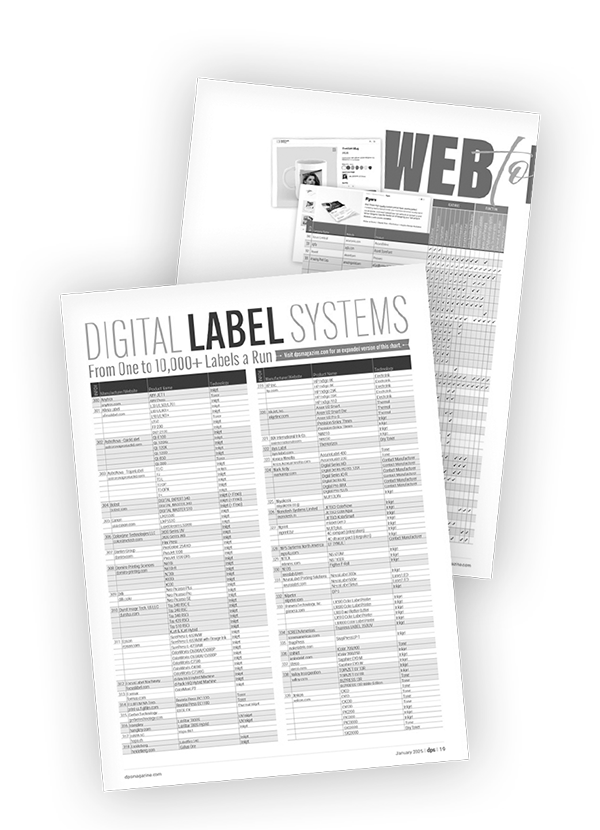
Labels represent a large segment of the overall packaging industry. Digital print is disrupting label production, addressing the latest demands for short runs and personalization. Research firm Smithers Pira indicates that in 2016, labels produced worldwide on digital presses were worth $9.46 billion. The firm says the market is expected to grow 10.2 percent year-on-year through the end of the decade.

What is Industrial Label Printing?
Industrial label devices are designed for durability, enhanced support, high production, quality, and robustness. A variety of digital label systems meet these demands.

“Industrial digital print systems are designed for higher duty cycles and production levels to support nearly continuous production in 24×7 operations,” says John Hennessy, senior business manager, Jetrion products, EFI. He adds that industrial print systems must be able to robustly accommodate a wide variety of substrates and applications, so that owners and operators can adapt to changing requirements and industry trends. “Because industrial-grade systems most often require a higher capital investment, idle time on the equipment must be minimized to assure the business receives the ROI as projected.”

Russell Doucette, assistant product marketing manager, Konica Minolta Business Solutions U.S.A., Inc., agrees. “The ability to run job after job, shift after shift, and week after week is imperative and expected in these types of devices,” he says.

Other vendors look to a product-based definition for industrial and consider it to be those sold primarily through business-to-business (B2B) channels and support more diverse substrates.

Amber Miller, product manager, Primera Technology, considers industrial label production to include, “a durable case or cover, and a cover that locks tight enough to block out dust and debris.” She says industrial labels often require inks and materials that withstand harsh weather conditions.

Ray Dickinson, marketing and business development VP, Mark Andy, points out that color and quality requirements during an industrial process are more sophisticated compared to commercial segments. “In fact, everything about industrial machines is dedicated to creating more products at faster rates.”

Digital Drivers
The push to digital label production for industrial purposes comes from a variety of needs across many industries.

For example, Mike Atkins, national sales manager, Afinia Label, says companies that produce food, nutritional supplements, and chemicals immediately see the need to produce labels digitally.

In these industries, many products with a small run of each individual product are in demand. He points out that managing the purchasing and inventory of many different pre-printed labels is both frustrating and costly. “These industries often purchase more labels than needed to achieve a certain price point, and discard those labels if there is a packaging change,” says Atkins. Digital label printing helps shops print on demand and in house.

Doucette sees the food, beverage, and nutraceutical markets surging into the adoption of digital labels. “The biggest advantage they have with digital production is the ability to customize, localize, and personalize a message for a particular group of consumers,” he says. Using digital label printers, these companies experience faster time to market and expand their sales opportunities.

Product and equipment identification labels also benefit from digital. “They demand the ability to print to a variety of substrates without priming or coating and they demand a finished print that is durable with or without coating or lamination,” says Mark Schlimme, marketing director, Screen Americas.

Sherry Land, software engineer, Neuralog, believes the adoption of label production printers is fueled by government regulations in large and small chemical, pharmaceutical, and consumer products. “We see activity in a variety of markets—cleaning chemicals, paints, supplement and vitamins, even electronic cigarette makers are now affected,” she says.

While it’s clear that many vertical markets utilize traditional label making processes, some see digital as the new norm. “Starting in 2014, more digital label presses have been sold than traditional analog presses. Converters and brands demand gravure-matching quality and the flexibility to address a wide spectrum of applications,” offers Brian Cleary, category manager, HP Indigo Label Solutions.

Technology Options
Digital label systems utilize either electrophotographic (EP)- or inkjet-based technologies. Both offer great benefits for label printing, depending on the needs of the job at hand.

Hennessy points out that EP presses were commercialized more than 20 years ago and were adapted to work in the label space before inkjet technology was advanced enough to compete. As inkjet evolves—including the introduction of higher dpi printheads, faster speeds, and advances in single-pass applications—the differences in the printed output are more subtle and usually require a loupe to discern, “so competition is fierce,” he suggests.

EP printing uses electrostatic charges, toner, and light from either a laser or LED to beam an image onto a drum and leave a positively charged replica. The image is then fused using heat and pressure to adhere to the paper.

This equipment features dry- or liquid-based toner options. Dry EP technologies feature toner particles and a thicker layer that fills in textured substrates when fused. It has a shiny appearance unlike flexography and gravure. “Once fused, it is unable to shrink or stretch without cracking so it is not suitable for shrink sleeves or stretch applications,” cautions Cleary.

Liquid EP can stretch and shrink. Cleary explains that HP Indigo ElectroInk can lay on the substrate in a thin layer and conform to textures without filling.

Doucette says that EP devices are suitable for about 80 percent of the pressure-sensitive labels today and daily maintenance is generally less intensive than inkjet solutions. He says for this reason, it may be a better option for a company to enter the market and explore digital printing benefits.

For PSPs that intend to print on shrink sleeve material, inkjet-based label production equipment is a good choice because it doesn’t rely on a heated fuser for image transfer.

Atkins explains that fuser operating temperatures place limitations on synthetic label material due to low melting points with polypropylene, polyester, and vinyl, leading to color matching difficulty in humid climates. “Inkjet is more accurate and repeatable because it is not affected by the ambient temperature and humidity of the production environment,” he says.

Speed and productivity is also a factor. Dickinson points out that inkjet-based label production equipment not only has long cycles but also produces at higher production speeds and productivity four to seven times greater compared to EP. It is also upgradable with minimal press replacements. However, he warns that inkjet inks have a thicker lay down and may also be brittle when cured.

Olaf Walter, president, mprint LLC, says inkjet label presses reach speeds up to 246 feet per minute (ft/min) whereas EP equipment prints at speeds near 98 ft/min in four color modes.

Inkjet is capable of being stopped and started during printing. Juan Kim, CEO, Valloy Incorporation, says it’s also easier to handle, especially because the printing environment is room temperature. “However, specifically coated media needs to be used for water-based dye pigment inks which are very weak against water and sunlight,” says Kim.
Hennessy suggests that EP-based systems may have the advantage when it comes to reproducing the smallest graphic features and text, but inkjet is shown to print on a wider variety of commercially available substrates without special primer or treatments, and UV inkjet technology provides added benefits including durability without overlaminate/overvarnish, higher print speeds, and lowest cost per print.

Color Considerations
One concern traditional converters have with digital production presses is reaching the color gamut that they are used to. Luckily, the latest tools in RIP, RIP software support, and color matching help to ease their minds.

Gernot Schneider, digital products product manager, Nilpeter Europe, says color gamut capabilities should be tested from case to case because it depends on the product and the machine. He adds that Nilpeter works with a special color calibration software and an extended color gamut to reach more than 90 percent of the PMS colors. Color calibration software eases traditional converters into the idea of digital label productions.

Thomas Jensen, product director, Trojanlabels, agrees, pointing out that extensive ink formula development and use of excellent color management products are a safe solution for traditional converters. “Of course, for CMYK there is a natural limit in reaching the full Pantone range,” he adds.

“Time and labor savings along with the ability to print many different jobs in the same amount of time will often more than compensate for the slightly different color you may see in a CMYK workflow,” says Doucette. To achieve a closer match to their current labels, companies should be trained on the creation and use of ICC profiles and spot color matching.

Converters should also work with manufacturers to test the total color gamut and the ability to manage and match specific LAB values. “Expanded gamut colors, such as fourth and fifth orange or violet or light cyan and light magenta can expand a presses ability to reach hard to match colors but can come at a cost to productivity as well as added running costs,” says Schlimme.

Most digital machines allow for 85 percent match of the PMS gamut using the basic CMYK plus white setup. “This can be increased by adding orange, green, and violet to about a 98 percent match. The remainder is usually covered by spot colors,” says Walter.

Software RIPs help create label stock-specific color profiles and the ability to dial in and replace spot colors without alteration. “We strongly recommend this option for anyone who is required to reproduce pantone colors on label material. This RIP also allows for output profiles allowing the digital press to mimic the output of other offset or flexographic presses,” adds Atkins. He explains that dye-based aqueous inks produce a higher range of colors for process printing at affordable prices.

Speedy and Robust
Traditional converters also require speed and robustness from their digital selections. In an industrial environment, efficiency is everything. Traditional converters want assurance they can meet existing duty cycles.

Just as important as the quality of the labels, run length is another consideration. “The breakeven point compared to flexography is currently 5,000 impressions or 100,000 labels,” says Schneider. Digital label production printers work best in short runs, unless they are being used for personalization that isn’t capable on a traditional label printer.
Miller believes traditional converters should separate jobs based on size and use digital presses for shorter runs to fill the gap of short-run labels that are too small to run on flexo machines. In this way, traditional converters ease into digital label production.

Atkins advises print providers to look at construction and costs. Converters who only run flexographic presses and want to move into digital should begin with a small digital press that is versatile and doesn’t require a large capital investment.

Traditional converters can also ask manufacturers for multiple reference sites with similar production environments to ensure the press meets their specific production needs. Cleary adds that traditional converters should evaluate the manufacturer’s service capability to discover if they own the imaging technology or integrate licensed technologies.
It is also important to consider finishing needs. Walter comments that it is rare to find a digital label press that offers “true inline converting, such as laminating and die-cutting.” He adds that these functions usually require a secondary process and, therefore, increase the required investment.

Industrial Environments
Several different industrial vertical markets adopt label production printers because of their ability to customize, localize, and personalize messages for specific consumer groups. The food, beverage, and nutraceutical markets are early adopters of digital label production printers.

According to Cleary, in 2014 more digital label presses were sold than traditional analog presses due to demands by converters and brands for gravure-matching quality and flexibility for a wide spectrum of applications.

Companies that produce a lot of products but small amounts of each individual product benefit from digital label systems. This can be items with different flavors or variations of one product, like wineries. “Many require requests of short run jobs with vivid color saturation and differentiated touches,” says Kim.

Miller shares that globally harmonized system of classification and labeling of chemicals color regulation changes have forced chemical manufacturers to label their chemical drums with specific color coding and information. “Most demand a label printer that prints full color and has labels and inks that have passed BS5609 testing,” she says.

Mislabeled
While digital label press adoption increases, there are still some challenges to consider.

Kim says that computer and software skills are the first barrier. Quality issues can happen any time, but he believes developers should focus more on digital print’s flexibility rather than microscopic quality analyses.

Doucette says that one of the most major challenges slowing down the adoption rate of digital label presses is the initial cost of acquiring the equipment. “As the costs come down and better ROI and customer success stories emerge, more industrial companies will entertain bringing digital label production in house,” he predicts.

Finding substrates that are available and cost effective to compete with conventional non-digital substrates and media is also difficult, according to Schlimme.

Navigating inherited legacy infrastructures of analog finishing equipment are also a challenge for label converters adopting digital technologies. Kevin Abergel, marketing and sales VP, MGI, says, “digital finishing is a whole new frontier and the last mile for digital penetration. The traditional methods of label finishing typically involved many different types of specialized equipment and this prevents true straight-through processing and seamless workflows.”

Hennessy admits there are many factors hindering the adoption of digital in industrial label environments. However, “indecision can play a large role here.” He says that frequently, traditional shops stick with what they know, find new ways to shave off a little more cost in their process or take on additional activities like managing their customer’s inventory to help bridge the gap between cost effective long runs and cost effective short runs. “In addition, there are many new digital print systems on the market to sort through and evaluate, and most print producers have their own mix of jobs and production workflows that must be accommodated by the new technology, so the due-diligence burden is not trivial,” he suggests. “Strangely enough, many decision makers involved in capital and equipment planning may not have accurate information about their true costs of production, so may not be compelled to seriously evaluate new digital technology or learn how it can save cost and generate new revenue.”

Labeling the Future
As the landscape of digital label production presses develop, we asked digital label press vendors what they think the industrial label market looks like.

Schlimme points to wider widths and adds that speeds will likely improve. “Developments in ink technology will drive digital into flexible packaging markets as well as consumer product goods that require labeling and packaging with low migration inks and protection against contamination,” he says.

Kim sees pigment, latex, and UV inkjet dominating the market in the future—rather than toner-based technologies.
Doucette adds that digital embellishments like spot varnish, digital foil stamping, and 2D and 3D texture mapping is expected in the future.

Dickinson believes that hybrid technologies, fully integrated inkjets with SMED, converting, and decorating, will have a secure place in the label market. In addition to the development of ink sets, software systems, and workflows, he says that MIS and file management solutions will become more powerful, empowering converters who integrate these systems to become more productive.

“Once brand owners and consumer packaged goods providers—as well as their marketing teams and advertising agencies—realize the creative power of digital label finishing, the market will become dynamically energized with more attractive, eye-catching, colorful, and memorable products on the shelf,” predicts Abergel.

Label Printing
As label production technology advances, we see digital presses earning their keep in the industrial segment. Label presses serve a wide audience from food to pharmaceutical packaging. With the ability to handle the robustness expected for these applications, label converters overcome challenges hindering digital label press adoption and look to the future. dps

Jan2017, DPS Magazine