by Cassandra Balentine
Continuous- and web-fed inkjet technology keeps advancing, replacing more jobs traditionally printed with offset. Trends include predictive intelligence, short-run profitability, and high-coverage printing.
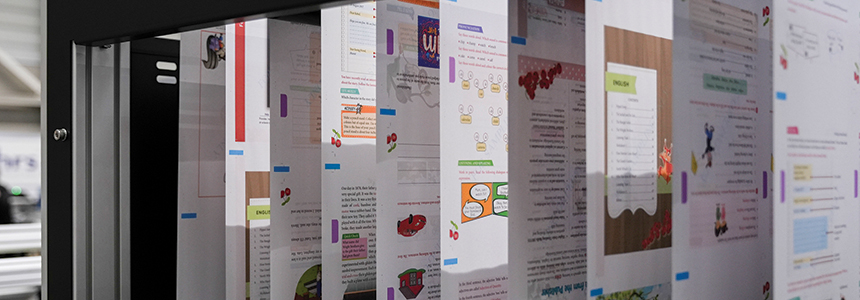
Above: KODAK ULTRASTREAM Continuous Inkjet Technology delivers very small drops and high resolution for offset-comparable output, while KODAK Stream Technology continues to push extreme productivity for high-volume production.
“Several trends are accelerating the adoption of continuous- and web-fed inkjet for work that was traditionally printed on offset. Run lengths are getting shorter, but total volume has not disappeared—it has fragmented into more frequent jobs with greater variation and tighter deadlines. At the same time, labor availability, waste reduction, and faster turnaround have become major operational priorities,” shares Josh Howard, senior director, inkjet R&D, print operations, Kodak.
As quality has improved, inkjet is now better positioned to handle higher coverage work, more demanding substrates, and applications such as direct mail, books, catalogs, magazines, and other jobs that increasingly need offset-like quality with digital flexibility. “That combination of productivity, economics, and application expansion is driving broader offset-to-inkjet migration,” he attests.
Looking at Printheads
From piezoelectric to continuous drop on demand and thermal inkjet, printhead technology continues to advance.
A key element in Canon’s web‑fed inkjet printhead implementations is the proprietary innovations the company applies to optimize ink control, jetting performance, print consistency, and operational reliability. “Our differentiation lies in the intelligence layered with the printhead—turning excellent hardware into an exceptional print system,” says Lucy Perez-Sierra, senior manager, product strategy, Canon U.S.A., Inc.
Canon utilizes advanced technologies such as Digi‑Dot multi-level modulation to enable precise droplet control and Pre‑Fire technology to help ensure stable jetting from the first print. “Innovations like printing on the ramp allow us to maintain quality and registration during acceleration and deceleration, to minimize paper waste and time to first sellable print while helping to maximize uptime,” offers Perez-Sierra.
Water‑jacketed printheads help ensure thermal stability under demanding duty cycles, allowing for extended high-speed operation without compromising print quality or nozzle reliability over time. Perez-Sierra says automatic printhead cleaning with micro purges proactively maintains nozzle performance to reduce operator intervention, optimize productivity, and help extend printhead life.
Additionally, to facilitate consistent output across the press width and over time, Perez-Sierra says Canon employs advanced color uniformity controls, reinforced by Canon Image Quality Control (IQC) technology. Using Nozzle Activation Control (NAC) and Nozzle Uniformity Control (NUC), the system continuously monitors and compensates for nozzle performance in real time.
“Our advantage is how intelligently we control, monitor, and optimize the printhead. By combining advanced jetting science, thermal management, automated maintenance, and real‑time quality intelligence, we offer outstanding image quality, consistency, productivity, and long‑term reliability, translating to lower total cost of ownership and higher customer value,” adds Perez-Sierra.
With a fully integrated approach spanning printheads, inks, presses, and workflow software, HP continues to invest in the evolution of web-fed inkjet.
Its PageWide Industrial portfolio includes the HP PageWide Advantage 2200, HP PageWide Web Press T4250 HDR, and HP PageWide Web Press T500M HD, all powered by the company’s proprietary thermal Inkjet technology and High Definition Nozzle Architecture—or HDNA—to bridge the gap between offset quality and digital production efficiency.
According to HP, PageWide customers have collectively printed more than 1.2 trillion pages worldwide, highlighting the continued adoption of web-fed inkjet technology.
Kodak printheads are part of a fully engineered continuous inkjet platform, not just a standalone component. Howard explains that Kodak designs the printheads, inks, imaging architecture, fluid delivery, workflow, and service model to work together, which helps deliver stable output, consistent pigment density, and reliable performance over long runs. “Our continuous inkjet architecture also supports accurate drop placement at very high speeds, broad substrate versatility, and industrial duty cycles that enable customers to run continuously rather than episodically.”
KODAK ULTRASTREAM Continuous Inkjet Technology delivers very small drops and high resolution for offset-comparable output, while KODAK Stream Technology continues to push extreme productivity for high-volume production. These advancements are driven by what printers need most today—the ability to migrate offset work to digital, handle shorter and more variable runs profitably, maintain image quality at speed, reduce operator dependency through greater automation, and expand onto coated papers, glossy stocks, and other demanding applications without sacrificing throughput.
Ricoh’s continuous-feed inkjet printheads are based on an industrial grade piezoelectric design developed over decades in demanding applications, such as large format printing, textiles, biomedical, and ceramics. “Experience across these industries has shaped a platform focused on durability and stable performance in high-volume production environments,” says Tim Bolton, senior manager, product management, Ricoh USA, Inc.
Built in-house using Ricoh’s Gen 5 piezo technology, Bolton explains that the printheads give direct control over performance and lifecycle reliability. They are designed for continuous operation with precise drop placement, supporting high uptime and image stability in web-fed production. “These characteristics are especially important for operations moving from offset to inkjet, where expectations for consistency and repeatability remain high.”
Driving Advancements
The latest advancements across Canon’s ColorStream and ProStream are driven by evolving customer demands for higher image quality, greater efficiency, and long-term stability. “As customer applications continue to evolve—spanning transactional, direct mail, publishing, and high‑value commercial print—our technology roadmap has been shaped by the need to deliver offset‑like quality, digital agility, and predictable performance at scale,” comments Perez-Sierra.
To maintain consistency across long runs and wide webs, the ProStream platform leverages advanced Canon IQC, including NAC and NUC and the ColorStream platform leverages CUC. “These technologies continuously monitor and compensate for nozzle‑level variations in real time, supporting exceptional color uniformity and repeatability, minimized artifacts, and reliable output that can remain stable not just page‑to‑page, but roll‑to‑roll and press‑to‑press. These controls are particularly valuable as customers expand fleets and demand interchangeability across production lines,” offers Perez-Sierra.
Along with consistency, productivity and uptime are key drivers, resulting in innovations such as water‑jacketed printheads, intelligent printhead capping, and automatic micro‑purge cleaning, all designed to maintain stable performance and minimize operator intervention and total cost of ownership, adds Perez-Sierra. “These innovations are deployed across one or both of the product families, with ProStream building on this foundation to help meet the needs of higher value, image‑critical commercial applications, while ColorStream continues to deliver outstanding quality and throughput in transactional and publishing workflows.”
Another important distinction, advancements are driven by real‑world production requirements, not theoretical performance gains. Perez-Sierra points out that customer feedback, application expansion, and the increasing convergence of offset and digital quality expectations have all influenced our development priorities. The result is a technology roadmap focused on predictable, repeatable quality at scale; faster job stabilization and reduced waste; lower operational complexity for production teams; and sustained performance over long press lifecycles.
Together, these advancements reflect Canon’s commitment to delivering predictable, high-quality production inkjet solutions—with Canon ColorStream for high-volume transactional and publishing applications, and ProStream extending those capabilities into higher value, image-critical commercial print. “While the ColorStream and ProStream product families address distinct market segments, they share a common technological DNA—rooted in intelligent printhead orchestration, advanced image quality control, and production‑first engineering. These latest advancements enable both platforms to not only meet today’s requirements but are positioned to support the next generation of inkjet applications as customer expectations continue to rise,” states Perez-Sierra.
Howard feels that several Kodak advancements support higher productivity on shorter, more complex runs. Automated maintenance features and operator-replaceable printheads help minimize downtime between jobs. Intelligent registration and stitching controls help maintain print quality with less operator intervention. Multiple print modes on the KODAK PROSPER 7000 Turbo Press let customers optimize speed and quality based on the application, while the KODAK PROSPER ULTRA 520 Press is able to maintain its highest image quality at full production speed. Open architecture also helps customers integrate inkjet into broader production lines, reducing extra steps, easing workflow complexity, and helping production teams keep output moving with fewer manual interventions.
Howard points out that high-speed, continuous-feed inkjet quality depends on far more than resolution alone. True image quality is the result of precise drop control, consistent ink behavior, accurate registration, smooth tonal transitions, clean line work, strong solid areas, and the ability to hold that performance at production speed.
Kodak’s continuous inkjet technologies are designed around that view of quality. Stream Technology uses highly accurate drop placement and continuous drop generation to support sharp text, fine lines, and image consistency at very high speeds, while also helping reduce the nozzle-related interruptions more common in drop-on-demand systems. ULTRASTREAM Technology adds even finer drops and higher effective resolution, but the bigger advantage is how those capabilities translate into real printed output—better highlight detail, smoother gradations, improved line straightness, more natural images, and stronger overall visual quality on the page. KODAK EKTACOLOR and KODACHROME Inks are also critical because image quality is not just about how small a dot is, but how well the ink performs on the substrate—delivering high optical density, stable color, clean drying behavior, and consistent results across long runs and demanding finishing environments. The goal is not resolution for its own sake; it is delivering image quality that looks better to the customer and remains consistent in real production conditions.
For Ricoh, two recent advancements significant to its continuous-feed inkjet development include liquid cooled printhead technology and real-time nozzle compensation.
Bolton explains that heat is one of the biggest challenges for inkjet printheads, particularly during long, high-speed runs. Even small temperature fluctuations can cause visible quality defects. “Liquid cooling stabilizes printhead temperature, which improves color consistency from start to finish, reduces mechanical stress, and extends overall printhead life. The result is greater durability and more predictable performance in demanding production environments,” notes Bolton.
As for real-time nozzle compensation, Bolton feels that random nozzle deviation or misfiring has been one of inkjet’s biggest challenges. “Today’s systems detect and correct nozzle issues in real time by adjusting neighboring nozzles. This reduces visible defects and keeps production running without operator intervention.”
According to Bolton, both advancements were driven by customer demand for higher uptime, longer runs, and offset-level consistency, particularly as more applications move to inkjet.
Driving Inkjet Forward
The adoption of high-speed inkjet, specifically continuous- and web-fed implementations are driven by the growth of data and digitally enabled business models. Print providers look for high speed, digital flexibility, and quality—all which are matched by these modern solutions.
“Web-fed inkjet is increasingly seen not as an alternative, but as a strategic complement to offset in modern print operations,” offers Bolton. “Higher quality and greater media flexibility mean that more jobs now fall into the ‘viable on inkjet’ category, including applications historically reserved for offset. As a result, continuous-feed inkjet is increasingly viewed as a true production alternative for a wider mix of commercial, publishing, and direct mail work,” he concludes.
Jul2026, DPS Magazine