by DPS Magazine Staff
Production print environments must consider cybersecurity. Threats include ransomware, unauthorized control of a press, theft of customer intellectual property, vulnerabilities in the software supply chain, as well as credential theft.
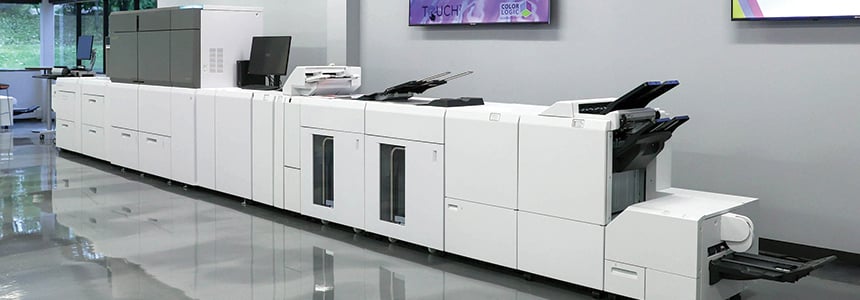
Above: The Sharp BP-1200 series utilizes multi-layered architecture and an optional BP-FR12U Data Security Kit.
Cybersecurity also involves protecting the production operation, maintaining continuity, and ensuring customer trust. “In production environments, digital presses are vulnerable to many of the same types of security risks as network computers,” warns George Grafanakis, director of product management, document systems products, Sharp Imaging and Information Company of America.
“Because these devices often handle confidential documents and are integrated into enterprise workflows, they should be managed with the same security care as other critical network-connected systems,” says Michael Pelfrey, advisory engineer, Ricoh.
Recognizing Threats
Cyberattacks on workflow servers, digital presses, digital front ends (DFEs)/RIPs, web to print (W2P) portals, and remote service gateways can stop production, delay customer jobs, and expose confidential data, resulting in financial loss.
Production print environments face many of the same threats as any enterprise IT environment—unauthorized access, ransomware, malware, credential theft, insecure or unnecessary network services, unpatched systems, and data exposure. “What makes print different is not the threat list—it’s what is at stake. Print workflows routinely handle customer data that belongs to someone else—names and addresses, account numbers, statements, as well as medical and financial correspondence. A print provider holds that data on behalf of clients who are themselves regulated, so an incident carries contractual and compliance consequences beyond the shop’s own operations,” comments Aucan Czakis, product marketing, manager, Fiery.
Vulnerabilities
Endpoints on the network can be vulnerable. “If unique login passwords and administrator passwords are not maintained on the devices, the risk of malicious attacks becomes very high,” offers Grafanakis.
Production drives may hold sensitive materials. Mike Betsko, senior director, business planning and strategy, enterprise and solution products, Canon U.S.A., Inc., says if compromised, this could result in compliance issues.
Workflow connectivity is a cybersecurity threat. Modern print operations accept work through hot folders, automated job submission, W2P portals, MIS/ERP integrations, and cloud services.
Secure DFEs should support timely software updates, hardened operating systems, controlled network ports, secure integrations, and centralized identity management, according to Czakis.
Network pivoting is another concern. Betsko says attackers use devices with weak security as a “beachhead.” Once they compromise the DFE, they can pivot laterally to attack other systems.
A blog posted by Kodak, Why Security in the Print Industry Matters More than Ever, notes that while the digital transformation has unlocked new efficiencies, it has also introduced new vulnerabilities, especially in the software that powers modern print operations. As a result, printers can no longer afford to be complacent. “They must be agile and responsive to meet evolving challenges, especially when it comes to proactive security strategies.”
Physical and insider access is another risk. “Production floors are busy, shared spaces where job files sit on servers and printed output sits on pallets. Unrestricted operator accounts, shared administrator credentials, unattended output, and drives that leave the building for service are all realistic paths to a data loss that circumvents the digital network,” says Czakis.
Betsko agrees, suggesting that malicious or careless employees can exploit weak access controls to print unauthorized copies of sensitive documents or siphon off data using USB drives.
Cybersecurity Considerations
Digital production printers and presses are not isolated islands; they are fully networked nodes, making them potential targets like any other technology today, notes Betsko.
As Kodak’s blog says, “across the print industry, print security is no longer just an IT issue, it’s a business imperative.”
Oct2026, DPS Magazine