by DPS Magazine Staff
Coating is a popular method for both aesthetic and protective reasons. When it comes to digitally printed output, several nuances are considered for the best results.
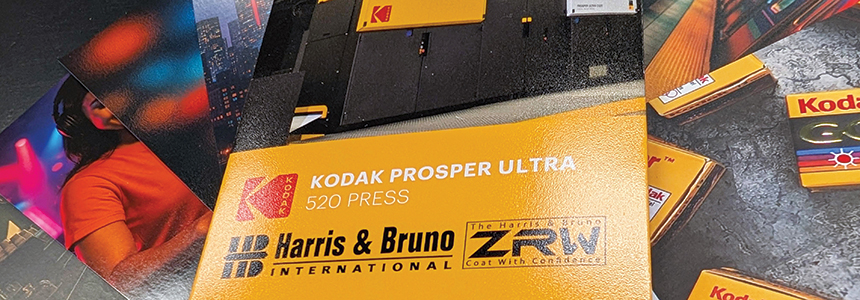
Above: Harris & Bruno’s high-speed ZRW coating systems are built to keep up with modern inkjet web press speeds.
Digital Specific Considerations
Poor adhesion between the coating and the printed surface may lead to flaking.
Juan Soto, global director of web and coating, Harris & Bruno, explains that high-wax digital toners can create a low-dyne surface that makes it difficult for coatings to properly wet out and anchor. “Generalizing toners is a bit difficult because each OEM uses different chemistries and compounds. Especially with the increase in speeds, these toners will differ between models within the same OEM.”
In some instances using an inline corona treatment can change the dyne level and help with these challenging-to-coat toners, offers Soto. In other cases, chemistry alone may be a solution. “However, in a majority of cases, the issue is not just the coating itself but the interaction between toner, media surface characteristics, coating chemistry, and the application method.”
Digital-ready primers help adhesion by creating a more receptive surface between the print and the coating layer. “Instead of asking the coating to bond directly to a difficult toner or ink surface, the primer improves surface energy and creates a stronger foundation for pigmentation adhesion. This is especially important in mixed digital environments where toner and ink sets vary widely. A well-matched primer can improve bond strength, reduce flaking, support better durability in finishing, and allow for higher value coating effects,” explains Soto.
Configurations
Inline, offline, and near-line coating configurations each have a place in the industry, and the best fit depends on equipment, production goals, and job variations.
Chad Ferguson, VP of sales, MBO America, explains that MBO offers multiple web coating solutions that are able to run inline with a press, or near-line—integrated within a finishing solution. “We position coating solutions inline with a press for maximum efficiency and throughput of flood coated—UV or aqueous (AQ)—especially in high-volume, roll-to-roll print production.”
Inline coating offers the greatest efficiency when the workflow is stable, has a repeatable application, and the press and coater are well matched, explains Soto.
While inline makes sense when volume is consistent, near-line configurations allow printers to stay agile without sacrificing too much efficiency, according to Ferguson.
Near-line placement offers a balance of flexibility and productivity, particularly in a print environment with multiple roll-to-roll presses. Ferguson adds that the near-line placement allows coating from any available press, without the capital expenditure of a dedicated coater for each press.
Near-line coating reduces handling and shortens turnaround times. “Ensuring that the coating unit can keep up with the press speed is critical to avoid bottlenecks or slowdowns. A great example of this is our ZRW Web Coater, which is frequently paired inline with digital web presses, specifically for its ability to match press speeds,” notes Soto.
For many mid-sized shops, near-line is often a better long-term fit unless they have a consistent, high-volume production model. “Inline can be the right choice when the press and coater are engineered to run together and the workload justifies it, but many mid-sized operations benefit from the flexibility of near-line. It allows them to coat work from multiple sources and avoid having finishing constraints directly impact press productivity,” shares Soto.
Offline coating provides independence from the press itself. Soto says it is ideal for shops that want a dedicated finishing step, need flexibility across multiple print sources or lines, or want to avoid tying coating directly to press uptime.
For example, many printers use the Harris & Bruno ZR sheet-fed coater specifically as a hub to route work requiring coating. “The ZR is especially enticing for its dependability in high-volume environments to deliver consistent results and recall recipes for past jobs. The trade off may be additional handling and one more production step, but generally we can typically show higher throughputs than anything else on the market,” comments Soto.
Coating Equipment
A range of coating equipment serves the digital print space, from roll-to-roll to sheet-fed applications in AQ and UV. Here are equipment highlights across this range of options.
Contiweb | The Contiweb Variable Coater (VC) is a high-end system that can post-coat paper after printing it. The VC uses patented automated metering technology to precisely apply the coating layer on the web, causing no standstill during a web width change or when changing the coating layer thickness. The Contiweb VC also allows users to prime low-cost offset paper in house. According to the company, this allows for savings up to 30 percent on paper costs compared to mill treated inkjet paper.
Duplo | Duplo offers digital spot UV coaters including the DDC-810 and DDC-8000. The DDC-810 provides print embellishment up to B3 size without the use of screens or dies. The glossy shine of the varnish elevates printed applications into premium products delivering standout designs with texture that you can touch and feel. The DDC-8000 offers an optional inline foil processing, expanding the possibilities for accurate digital spot UV printing. With Spot UV printing and foil processing with a three-dimensional effect, users can realize a more luxurious print sheet. In addition, it supports B2 size paper and can propose spot UV printing plus foil processing solutions for the packaging industry.
EMT International | The Chameleon Coater/Primer/Printer is available in three models. The UVF20 is a high-performance coater designed to deliver outstanding results for a range of substrates. It can deliver a matte or gloss finish and integrate with new or existing digital print production and finishing lines.
The Chameleon Coater is suitable for roll-to-coat to sheet, roll-to-coat to fold, roll-to-coat to bind, and roll-to-coat to roll applications, making it the perfect solution for postcards, book covers, calendars, mailers, yearbooks, brochures, photobooks, and manuals.
Graphic Whizard | The VividCoater Series of UV coaters are a low maintenance UV cured coating system that produces a high-quality finish to the printed sheet. With a range of finish options, including satin, soft touch, matte and high gloss, UV coating not only makes printed products more lively and brilliant but also offers powerful protection against friction and fading. Compared to conventional solvent-based coatings, the VividCoater produces virtually no volatile organic compounds and is considered to be environmentally friendly.
Harris & Bruno | Harris & Bruno offers a range of coating solutions designed for various print environments. Its chamber-anilox technology has been the heart of its systems for over 50 years. They are used in both sheet-fed and web applications and are valued for their consistency, clean laydown, and ability to support a variety of both AQ, UV, and priming applications.
On the sheet-fed side, the ZR units support both standalone and integrated coating workflows for digital print providers looking to improve protection, appearance, and overall piece value.
On the web side, the high-speed coating ZRW systems are built to keep up with modern inkjet press speeds for applications such as pre- and post-coating. In some instances printers will have a ZRW before and after their print unit so that they can both pre-coat and post-coat in a single run.
The company also offers Synergy Coatings, its proprietary line of AQ, UV, and specialty coatings. Developed with its application systems, these coatings target customers that want predictable performance, strong visual results, and dependable production efficiency.
Hoenle | Hoenle’s UV systems for curing coatings deliver high-quality results even on heat-sensitive substrates. The customized converting solutions are used for the most demanding surface finishing applications—for example, in adhesive curing, siliconizing, hard coating as well as matting. The advantages of its coating solutions are the combination of functionality, protection, and sensory appeal. Scratch resistance, additional features, and durable surfaces are achieved through innovative technologies such as curing in inverted conditions. At the same time, tactile surfaces add emotional value for end customers.
Kompac | Kompac provides flood and spot UV/AQ coaters, such as the Elite and EZ Koat systems designed specifically to work inline with digital printers.
Konica Minolta | Konica Minolta offers the MGI JETvarnish 3DS, which provides customers with ultra-precise spot coating—handling digital or offset originals in long or short runs, even varying the thickness of your coating for attractive prints with tangible depth that increases communications impact.
MBO | MBO offers two inline coating solutions designed to support a range of applications and production environments, giving operators flexibility in how to add value to a finishing line.
The SSC 23 Single-Sided UV Spot Coating Unit provides targeted, high-impact enhancement by applying coating in precise registration to highlight elements like logos, images, or text—ideal for direct mail and marketing pieces where differentiation matters.
For full coverage, the FC 23 Coating Unit, available in AQ, UV, or a combination applies consistent coating across the entire web at production speeds, adding durability and tactile finishes such as gloss or matte, making it well suited for high-value printed collateral.
Together, these solutions allow users to position coating as both a creative enhancement and a functional upgrade, helping expand capabilities and increase overall value in every printed piece.
Plockmatic | The Plockmatic DigiCoater Pro 400 HD-LED Paper coating machines provide an ideal finish that enhances and protects printed sheets. Environmentally friendly and featuring a unique curing process, this coating machine adds value to printed sheets at a fraction of the cost of traditional laminating, according to the company.
Scodix | The Scodix Ultra 6500 SHD is designed for packaging, publishing, commercial printing, and trading cards. It offer 17 Scodix Applications and is a B1/41-inch format machine.
TEC Lighting | Among its offerings, TEC Lighting provides the GX Coater. It is developed for B2 coating applications and is designed to set new benchmarks in versatility and productivity. The device is capable of running up to 4,500 sheets per hour, maximizing throughput and efficiency.
TRESU Group | TRESU’s modular coating systems apply full-surface, spot and line varnishes inline with the latest digital printing presses from OEMs.
Coating Options
Coating is a popular and often required finishing task for an array of digitally printed applications. Inline, near-line, and offline solutions are available in both AQ and UV formats.
Working with an experienced provider is recommended when determining the best fit for your environment.
Jul2026, DPS Magazine