by Cassandra Balentine
Cost and complexity are two challenges preventing adoption of SSO and related eprocurement tools, like PunchOut.
“Building or maintaining cXML/PunchOut support takes some technical investment. If a provider’s client base is mostly small to mid-sized accounts ordering direct, the return on investment may not be there yet. It pays off more once you’re actually chasing enterprise volume. For this reason, we offer these options as module add-ons. You don’t need to pay for it until your business is ready to take that step,” explains Pablo Jaramillo, product manager, MarketDirect StoreFront, CAI Software.
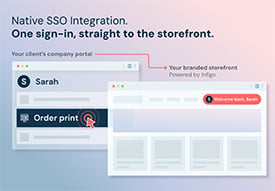
A lack of understanding is another concern for many. “It’s perceived as too technical, and without the right platform, it genuinely can be. Infigo takes that burden away from our customers. SSO/PunchOut can be enabled and configured on a per-customer basis, so a print provider only switches it on for the enterprise accounts that actually need it,” offers Alex Bowell, managing director, Infigo Software.
“A lot of print providers still see this as more complicated than it really is,” agrees Ayelet Szabo-Melamed, VP, marketing, XMPie. “If you’ve built a successful business around traditional W2P, it’s easy to assume that PunchOut, SSO, and procurement integration are only relevant to the very largest enterprise accounts.”
Szabo-Melamed believes there’s a perception that these projects are expensive, technically challenging, and require specialist expertise. “But the market is changing. More large organizations now expect suppliers to fit into their existing procurement processes, and in many cases procurement integration it’s a prerequisite for doing business. For print providers looking to move upmarket and win larger, longer term contracts, procurement integration is increasingly becoming part of the cost of entry.”
Another challenge is not having an integration layer and having to reinvent that layer for every customer. A major enterprise account can justify a PunchOut implementation. The economics become much harder if every new customer requires another one-off codebase, another support model, and another set of operational dependencies.
“The scalable approach is to separate procurement logic from the personalization engine, but make the integration layer reusable and configurable wherever possible. Customer-specific mappings will always exist, but they should be configuration work rather than a completely new software project each time,” adds Dmitry Sevostyanov, CEO, Customer’s Canvas.
For a lot of smaller or single-location print shops, David Graves, CEO, Aleyant, admits this level of integration is more infrastructure than they need. “cXML punchout and enterprise SSO exist to solve a specific problem, managing complex approval chains and system-to-system data flow at scale, and if you do not have clients with that kind of procurement complexity, the setup effort and ongoing maintenance can outweigh the benefit.”
There is also a real cost consideration. “Building and maintaining ERP connections, even through a platform’s App Marketplace rather than custom code, takes configuration time and some ongoing IT attention. A shop that mostly serves small local businesses is usually better served focusing on a clean storefront and fast turnaround than chasing enterprise procurement integrations nobody on their client list is asking for,” adds Graves.
Reducing Mistakes
There are common technical and/or configuration mistakes commercial printers make when attempting to onboard a client’s internal portals for the first time.
Alex Bowell, managing director, Infigo Software, says it is important that the certificate and security configuration are not mismatched. SSO security settings on both sides have to match exactly, and the standards are intentionally strict. Getting this alignment right the first time, rather than discovering a mismatch after going live, is where most onboarding friction happens.
Another common pitfall is underestimating the client’s internal approval and role structure. “Providers treat it like a simple catalog setup instead of mapping out cost centers, approval tiers, and PunchOut session handoffs up front. Skipping that discovery step is what turns a two-week onboarding into a two-month one,” cautions Jaramillo.
Graves warns against underestimating the client’s approval hierarchy. “Printers often configure a single generic approval step when the client actually needs multiple tiers based on dollar amount, department, or role, and that mismatch causes orders to stall or get approved by the wrong person.”
“The biggest mistake is assuming that procurement integration is just an IT project. It’s tempting to focus on getting the systems connected and declare victory, but that’s usually the easy part. The real work is understanding how the customer actually buys print. Who approves orders? How are budgets managed? What products should be available to different users? What reporting does procurement need? If those questions aren’t answered up front, problems tend to appear later,” admits Szabo-Melamed.
Graves also suggests treating SSO as an ongoing relationship, rather than a one-time technical checkbox. “User roles change, employees leave, departments reorganize, and if the printer is not prepared to update permissions on an ongoing basis, the portal drifts out of sync with the client’s actual org chart.”
Another challenge is when teams are stuck on designing for today versus for tomorrow. Enterprise customers rarely stay static and what starts as a single storefront for one department can quickly expand to multiple business units, different user groups, approval hierarchies, and negotiated pricing arrangements. “The most successful implementations are the ones that think beyond the initial launch and build a framework that can scale as the customer’s needs evolve. Otherwise, what looked like a simple onboarding project can turn into a series of expensive workarounds six months down the line,” says Szabo-Melamed.
A final mistake is treating onboarding templates as a one-for-one migration exercise. “Rather than simply recreating dozens of legacy templates in a new portal, it’s worth asking wither they can be consolidated into a smaller number of dynamic, personalized templates. This simplifies ordering, reducing maintenance and creates a more scalable solution for bother the customer and the print provider. In many cases, organizations discover that hundreds of static templates can be replaced by a handful of intelligent templates driven by business rules, branding controls, and personalization, significantly reducing ongoing administration while improving consistency,” shares Szabo-Melamed.
The full workflow must preserve the relationship between the buyer, the product, the price, and, in the case of personalized print, the exact design through cart transfer, corporate approval, purchase order creation, and production. “Teams also tend to focus on the happy path and under-test what happens when pricing changes, an order is retried, identifiers do not match, or a transaction fails halfway through. Those exception scenarios are often where an apparently successful integration becomes an operational problem,” notes Sevostyanov.
Read more on SSO adoption for W2P in the November issue feature, Easing EProcurement.
Dec2026, DPS Magazine